Welcome to the April Knights Legislature
This site contains the official statutes and laws of the April Knights — a community bound by fun, honor, and good governance.
📜 Statutes (This Section)
The documents in this section are the codified rules — the active, structured statutes that govern how the April Knights operate. These cover everything from elections and battalion organization to trials, membership rights, and leadership duties.
Statutes are living documents: they define the rules currently in effect and are updated as new laws are passed.
📘 Laws (See the "Laws" Folder)
The Laws folder contains every bill that has been passed by the April Knights. These are the legislative acts that:
- Create new statutes
- Amend existing ones
- Repeal outdated rules
- And often provide important background, purpose, and context for why a statute exists or changed
By reading the Laws, you can trace the evolution of our statutes and understand the intentions behind the rules.
Together, these folders form the legal framework of the April Knights. All documents listed here have been reviewed, voted on, and passed by both the lower and upper council as required by the statute on legislation Statutes define what the rules are, while Laws explain how and why the statutes came to be.
Battalions
The battalion is the core organizational unit of the April Knights. They are the tools that the Grandmaster uses for planning, and their quality is of the utmost importance for the collective success of the Order. This act is to set maximums on the amount of members a battalion can have and how many Officers should be in each battalion.
Section I
A battalion is not to exceed one hundred (100) members. The make up of a battalion will consist of one (1) Commander, up to nine (9) Officers, and up to ninety (90) Oathsworn Knights, inclusive of any Corporals present among the Battalion’s ranks.
Section II
Among the nine (9) Officers, one will be designated the “First Officer.” The First Officer is responsible for casting the battalion vote in the Lower Council, if the Commander sits on the Upper Council. As such, the First Officer can be given to a Sergeant even if higher ranked Officers are present, as best suits the needs of the battalion, and at the Commander’s discretion. The First Officer has no responsibilities in the Upper Council, and as such, their main priority is the management and monitoring of their battalion. While the final authority rests with the commander, the First Officer is empowered to make operational calls when the commander is otherwise occupied.
Section III
All battalions fall under the supremacy of the Grandmaster and the authority of the Councils, of which all Commanders are a member. Commanders who fail to recognize the supremacy and authority of either the Grandmaster or both of the Councils are guilty of insubordination and should be removed from their position of command.
Section IV
This act shall take effect as soon as voted and approved by both Councils, and confirmed by the Grandmaster.
Character and Language
Article 1 - Language Standardization
Section I
English is to be set as the standard for all official knight legislature and communications.
Section II
Understanding that not every knight has an English background, let alone a background in the same regional variant of English, the utmost compassion and understanding is required when discussing syntactic and grammatical issues in Knight documents and communications. The violation of grammatical and syntactical rules is to always be given a lower priority than conveyed meaning. This also applies to the use of different regional variants of English, as meaning conveyed should always have more priority than adherence to a very inconsistent language.
Section III
All legislation, in order to ensure accessibility to all inside the Order, should include an abstract at the beginning that summarizes the legislation’s intentions and actions in the most clear and easy to read diction possible, avoiding “legalese” whenever possible. This abstract does not serve to dictate official policy, but rather provide general insight into the function of said legislation in easily understood wording.
Article 2 - Text Character Standardization
Section I
Only ASCII (American Standard Code for Information Interchange) characters are to be used in official Knight documents. This avoids confusion and incompatibility with regionalized characters in other sets (e.g. Unicode).
Article 3 - Implementation
Section I
This act shall take effect as soon as voted and approved by both Councils, and confirmed by the Grandmaster.
The Constitution of the April Knights
Preamble
Our Order was founded in the days of the Button as a force of balance and a beacon of hope. We strive to spread the glory of our Order far and wide, to unite the people of Reddit towards a common goal, and to oppose the evil forces of chaos that seek to ruin the fun of the April Events.
Article 1 - The Grandmaster
Section 1 - Position
- The position of Grandmaster is supreme commander of all Knight forces and is the chief executive. The Grandmaster has full power to exert their authority over all operations.
Section 2 - Appointment
- The Grandmaster is voted in by the consent of our order by a popular vote.
- To be eligible to run for Grandmaster, a candidate must both have the rank of Captain or higher, and have participated in two full campaigns.
- Additionally, a candidate cannot nominate themselves, and must have another Knight nominate them for the position and a second Knight to second that nomination. Only then can the nominee accept and register as a candidate for election.
- The Grandmaster shall serve a term lasting from the moment they are sworn in until the next Grandmaster is sworn in.
Section 3 - Powers
- The Grandmaster has full authority to declare war and negotiate all treaties during times of both peace and war.
- The Grandmaster has the power to introduce legislation.
Article 2 - The Upper Council
Section 1 - Membership
- The Upper Council shall consist of the Grandmaster, the First Ranger, the First Herald, the First Builder, the Grand Inquisitor, the leader of the Arcanaeum, and up to two advisors, all appointed by the Grandmaster.
- The Grandmaster shall have the power to change their Upper Council upon being elected to office. If a member of the Upper Council leaves of their own choice, the Grandmaster shall have the power to appoint one new person to the Upper Council, moving seats if necessary. Further than this, if the Grandmaster wishes to make changes to the Upper Council, they may petition for the consent of the Lower Council via a simple majority vote no sooner than three months since the last Upper Council change.
Section 2 - Powers
- The Upper Council has the power to introduce legislation.
Article 3 - The Lower Council
Section 1 - Membership
- Each battalion commander will be a member of the Lower Council and is entitled to one vote therein.
- If a battalion commander has obligations in the Upper Council, the battalion’s First Officer, whatever their official rank is, will take their Commander’s place in the Lower Council.
- Should there be a case where a Battalion is represented in the Lower Council by a First Officer and that individual is called to also serve on the Upper Council, the position of First Officer must be passed to the next individual worthy of the responsibility of serving in the Lower Council for their Battalion.
Section 2 - Powers
- The Lower Council has the power to introduce legislation.
Article 4 - Legislation
Section 1 - Viewing
- All proposed legislation must have the ability to be viewed by the public for 2 weeks before voting.
- If legislation needs to be passed during an April Event, Section 1.1 can be waived.
Section 2 - Voting
- All legislation must pass both Councils with an absolute majority and be approved by the Grandmaster.
- The Grandmaster has the power to veto all legislation either Council passes. Both Councils have the power to bypass a veto with two-thirds absolute majority of both Councils voting in favor of the legislation.
Article 5 - The Battalions
Section 1 - Creation
- The Grandmaster has the authority to raise battalions, either new or through reinstatement, with a simple majority of the Upper Council.
Section 2 - Leadership
- The Grandmaster has the power to nominate candidates for commanders of any battalions raised.
- New appointments are confirmed by a simple majority of the Upper Council.
Article 6 - Emergency Powers
Section 1 - Enactment
- Both Councils have the power to grant emergency powers to the Grandmaster. This suspends the authority of both Councils.
- Invoking Article 6 must be approved by two thirds absolute majority of both Councils.
- The duration of Article 6 must be specified when being enacted.
- Article 6 cannot last more than 6 months after it is passed by the Councils.
Section 2 - Power
- The Grandmaster shall be granted absolute power for the duration of Article 6.
- The Grandmaster shall have immunity for the duration of Article 6 and shall have immunity for all actions during.
- The Grandmaster cannot use the mentioned absolute power to extend the duration of Article 6.
Section 3 - Rejection
- The Grandmaster has the power to reject Article 6 at any time against both Councils wishes.
- Should this occur, a two-thirds absolute majority vote of both Councils can give specific temporary powers, never absolute power, to an individual that is not the Grandmaster. The Councils cannot bestow these powers without the Grandmaster’s rejection of Article 6 being enacted at that time.
Section 4 - Revocation
- An early revocation of Article 6 proposed by a body other than the Grandmaster must be approved by two thirds absolute majority of both Councils.
Article 7 - Amendments
Section 1 - Enactment
- The Councils have the power to propose amendments to this constitution. The amendment must be ratified through a two thirds absolute majority in both Councils to be added to this constitution.
Definitions
- “Absolute majority”: The number of Yes votes must be counted against the total number of Yes, No, Abstain, and Absent. Unless specified otherwise, the default threshold for “majority” is over half.
- “Simple majority”: The number of Yes votes must be counted against the total number of Yes or No. Abstaining or failing to vote lowers the required Yes votes to pass.
- “Officer”: A Knight with the rank of Sergeant or higher.
- “Campaign”: The yearly Reddit April Fool’s event.
Document Standardization
Article 1 - Version Standardization
Section I
All legislation, referred to throughout as documents, proposed to and passed by the April Knights will be subject to the standards set in the Document Standardization Act.
Section II
Every document passed by the April Knights, both before and after this act was created, will receive a versioning number appended to their title (e.g. “April Knights Act” becomes “April Knights Act v.Major.Minor”).
Section III
The method to be used to identify bills moving forward will follow what has been used previously. This will utilize a two item identifier, “X-TYY.” “X” is the number of the current Grandmaster. As it pertains to this bill, “X” will only change when a Grandmaster is not re-elected and the position shifts to a new individual.“T” is the term number of the Grandmaster, and “YY” is the bill number assigned to it. E.g. The first bill during Grandmaster 7’s first term would be 7-101 and the first bill during their second term would be 7-201. If “Y” is a single digit, it will have a zero (0) placed in front of it, in order to maintain a 3 digit system. Upon the end of term for any Grandmaster, “YY” will reset down to one, written as 01, with any subsequent bill adding one (1) to “YY,” for the duration of the Grandmaster’s term. This is not to be confused with the version of the document.
Section IV
The numbers for each version are defined according to the template “vMajor.Minor” where ‘v’ simply indicates that the proceeding numbers refer to the version number.
- Major: Major refers to the amount of ‘major’ changes made to the document. This number starts at zero (0) and remains there until passed by the April Knights. At this point the Major number will upgrade to one (1). Incrementing this number afterwards will be extremely subjective, but the aim is to change it whenever the intentions of the document change or when the document will become unrecognizable from its previous state.
- Minor: Minor indicates the amount of ‘minor’ changes made to the document that have occurred since the last ‘Major’ version was incremented. Again, this will be extremely subjective, but the aim is to change it wherever grammar, spelling, minor formatting, or small rewording changes have been made. This number resets to zero (0) whenever the ‘Major’ version number has changed.
Section V
The version number for each document will only be incremented when the April Knights pass changes to a document. The document author can suggest a version number when proposing the document, but ultimately the Grandmaster and First Ranger are responsible for ensuring the new version number is given to the document.
Section VI
For documents that were not versioned prior to the passing of this act the Grandmaster and/or First Ranger will determine values to be approved by the Lower Council by a simple majority vote.
Article 2 - Maintenance Standardization
Section I
For the sake of preservation of April Knights history, the First Herald will appoint any officer ranked Captain or higher, other than the Grand Inquisitor, with the charge of maintaining April Knights documents. This Knight will be known as the Scribe. The First Herald may choose themselves, and the Scribe duties outlined would fall on them during periods in which the Scribe position is unfilled. The Scribe position is not an Upper Council position.
Section II
The scribe is responsible for ensuring every version of every document is stored securely in an accessible location. The documents should be stored in such a manner that it is easily verifiable that the documents have not been altered. The Grandmaster is responsible for ensuring this is the case.
Article 3 - Implementation
Section I
This act shall take effect as soon as voted and approved by both Councils, and confirmed by the Grandmaster.
Elections
The purpose of this law is to codify the necessary election traditions into formal law, set timelines for each step of an election, and serve as a set of instructions for the Election Administrator.
Article I - Election Administrator
Section I - Appointment
- It is the duty of the Grandmaster to nominate an Election Administrator for each and every election when an election is required, at the end of a campaign. The Lower Council is to approve the nominee with a simple majority vote so they can be appointed to that office. There are no qualifications to be appointed Election Administrator aside from that they cannot be a candidate in the election.
- The Grandmaster must select the Election Administrator before Jan 7th of the election year.
Section II - Expectations & Powers
- The Election Administrator must remain impartial throughout the duration of the election. They are forbidden from running in the election, endorsing any candidates, or making any political statements about the candidates, the election, and the April Knights.
- The Election Administrator has the power to create a space to provide information and updates for the candidates standing for election. For example, a discord group message with all candidates.
- It is the duty of the Election Administrator to ensure that the debate remains civil. Should any comments be inflammatory, break our rules, or otherwise out of line the Election Administrator retains the right to remove that comment. Any comments that are removed are to be reported to the Lower Council.
Article II - Electors
Section I - Registration
- Registration for an election must be opened no later than 24 hours after the conclusion of the April Event, or for any other reason if ordered by the Grandmaster. This is usually done via Reddit thread. Registration closes at the end of the voting window.
- All Oathsworn Knights are permitted to register for all elections. Registration is done by commenting in a Reddit thread created for the purpose of registration for the election.
- All Oathsworn Knights that register to vote will be notified when the voting window opens. This allows Knights to indicate that they are interested in participating in the election while they are active in the community. Registrations made after the voting window has begun do not need to be notified.
- The Elections Administrator is responsible for ensuring that all registered Knights are notified, but they may delegate the work to volunteers. There is no restriction on who may notify Knights to vote; this can include the Grandmaster Candidates.
- During the voting window, the Elections Administrator may choose to share a list of Knights who have not yet voted, and call for another round of notifications to this smaller list.
Section II - Inconsistencies & Invalids
- A registration is marked inconsistent when the registrant is missing an oath, missing a battalion, missing any history within the Order of the April Knights, is not in good standing with the April Knights, or is not a member of the April Knights.
- Should a registration comment have any inconsistency, it shall be marked invalid and thrown out. It is the responsibility of the Elections Administrator to see that the inconsistency is corrected. The Elections Administrator is also required to inform the Lower Council of these inconsistencies and their efforts to correct them.
- Should an inconsistency be unable to be rectified by the time of the election, the Elections Administrator needs to mark the registration and the subsequent vote as invalid. Should this occur, the Elections Administrator must inform the Lower Council.
Article III - Ballots
Section I - The Electoral System
- Voting is done in the method of ranked choice. The candidate to receive over half of the total valid votes within the voting period wins the election.
- Voters are to rank the candidates in order of their preference. For the first round of voting, all first choice votes are counted. The candidate with the lowest amount of first choice votes is eliminated and those voters move to their second choice. This continues until a candidate receives over 50% of the vote.
Section II - Creation of Ballots
- Ballots must ask for a voter's Reddit username. The ballots may also request additional identifying information, such as battalion and Discord name. This is to ensure the validity of the vote and the security of the election. Ballots must also have every candidate running on the ballot and a way for the voter to rank that candidate.
- A Google Form template of the ballot is to be made and stored in the April Knights google drive for future use. This template will be constructed in the manner outlined by this legislation. The Google Forms feature “Shuffle Option Order” must be enabled.
- Multiple ballot entries from the same voter shall result in their votes being marked invalid. If a voter communicates promptly and directly with the Election Officer about technical difficulties regarding their vote, unintentional duplicates will not disqualify their one vote, at the discretion of the Election Officer.
Article IV - Timeline of the Election
Section I - Registration
- The registration thread for the next election opens as detailed in Article 2, Section 1. The registration thread remains open until the end of the voting window of the next election.
Section II - Nominations
- The Election Administrator is chosen before January 7th. The Election Administrator will begin the election process by opening nominations between January 7th and Jan 15th. This is to prevent politics from being discussed during the holiday.
- The Election Administrator will begin the election process by announcing that Grandmaster nominations are now being accepted in the registration thread. Only nominations made after this announcement can be accepted. Nominations can be accepted as long as the thread is open and it’s before the start of voting.
Section III - Debates
- No later than 2 days after any candidate has accepted their nomination, a debate thread is to be made for Knights to ask questions and for candidates to campaign within.
- If only one candidate has accepted their nomination, the debate thread can be used as a Questions and Answers thread.
Section IV - The Vote
- 7 days after the election nominations have opened, voting should be held. If necessary, an extension of up to 3 additional days can be granted at the Election Administrator’s discretion.
- The voting period will last for either 14 days or until every single registered voter has voted, whichever comes first. After this period the winner will be declared unless there is a tie.
- As noted in Article 2, Section 1, notifications will be sent to all Knights who registered to vote. A second wave of notifications may be authorized to send to Knights that do not vote within the first 7 days.
Article V - Ties
Section I
- In the case of a tie between the final two candidates for office, a new debate thread will be made where both candidates will be able to have an additional debate. After three days of this new debate thread being live, a new vote will be held. This process will repeat itself until a winner can be decided upon.
Article VI - Political Speech
Section I
- All oathsworn Knights of the Order are permitted to exercise political speech in support or in opposition of candidates, as long as it is not inflammatory or breaks the rules of either the Subreddit or the Discord.
- The Election Administrator or moderators have the power to determine if posts related to the election and Knight politics are inflammatory or break our rules and have the power to remove those posts in violation.
- Commanders have the power to determine if posts in battalion chats or subreddits related to the election and Knight politics are inflammatory or break our rules and have the power to remove those posts in violation.
Article VII - Enactment
Section I
- This act shall take effect as soon as it is voted and approved by both Councils and confirmed by the Grandmaster, pending any implementation requirements.
Legislation
Article I - Legislative Procedure
How legislation is to be proposed, discussed, and passed within the April Knights organization.
Section I - Proposing Legislation
Changes to proposed Legislation are permitted during the period after its submission to the Council considering it, whether in private Council chambers, or in the public Conclave. There is a minimum of two weeks for a piece of legislation to be officially proposed before it can be voted on. In the course of debate, changes or edits are permitted until one week before the voting period begins. Should it be required that changes be made during the last week leading up to the vote, the vote must be rescheduled so that another week may pass for public visibility. As outlined in the Constitution, the timing and scheduling limitations may be waived during an April event. See Appendix I for workflow.
Section II - Discussing Legislation
All council members are to behave civilly and treat each other with respect worthy of all oathsworn Knights.
If any member of either council is found to be in violation of this act, a majority of the Triad have the full power to suspend any representative from partaking in as many sessions as they deem necessary.
The Grandmaster can bypass any suspension issued in this manner. When this bypass happens, the Grandmaster shall inform the Triad.
Section III - Voting on Legislation
The Grandmaster should schedule a vote for legislation, waiting at least 2 weeks for public viewing. The Grandmaster should also ensure all battalion representatives are notified of the scheduled date of the vote.
The voting period will last exactly 48 hours from the selected starting time of the vote or until every representative has voted, whichever comes first. All votes will be counted; any representative that fails to vote either Aye or Nay will be counted as an abstention. During the tally, should the vote counts clearly show either passage or rejection, the result may be published while not ending the vote early.
During the 48 hour voting period, no comments, arguments, or qualifiers will be permitted regarding the legislation being voted on. The time of the first introduction and the 2 weeks of it under public review, to any time afterwards is where such action is permitted.
Article II - Appendix
These are examples for the purpose of making the process clear and not a hard requirement to be followed.
Example Workflow I
- Legislation is submitted to the Upper Council for review and discussion.
- Edits, changes made as determined necessary.
- Grandmaster or First Ranger submits Legislation to the Lower Council for review, comments, and debate.
- Edits, changes made as determined necessary.
- Grandmaster or First Ranger submits Legislation to Conclave and posts the link for it to Proposed Acts, with the scheduled voting period.
- Comments and debate due to increased audience.
- Member of the Lower Council suggests edits, resulting from a requirement revealed during open discussion.
- Grandmaster or First Ranger confirms general support for the edit.
- Grandmaster approves or denies edit.
- One week before the scheduled vote, no further changes permitted.
- Public viewing period ends; all discussion, debate, and queries cease.
- Voting period opens; both Councils vote for or against Legislation in its entirety.
- Upon passage, the Grandmaster or First Ranger publishes it as Law in mandated locations.
Example Workflow II
- Legislation is submitted to the Lower Council for review and discussion.
- Edits, changes made as determined necessary.
- Legislation is reviewed and discussed simultaneously in the Upper Council.
- Edits, changes made as determined necessary.
- Members of the Upper Council submit proposed changes to the Lower Council as determined necessary.
- Grandmaster or First Ranger confirm that the discussion on the Legislation has concluded in both of the Councils and no further changes or debate are required.
- Grandmaster or First Ranger submits Legislation to Conclave and posts the link for it to Proposed Acts, with the scheduled voting period.
- Comments and debate due to increased audience.
- Member of the Lower Council suggests edits, resulting from a requirement revealed during open discussion.
- Grandmaster or First Ranger confirms general support for the edit.
- Grandmaster approves or denies edit.
- One week before the scheduled vote, no further changes permitted.
- Public viewing period ends; all discussion, debate, and queries cease.
- Voting period opens; both Councils vote for or against Legislation in its entirety.
- Upon passage, the Grandmaster or First Ranger publishes it as Law in mandated locations.
Line of Succession
Section I
The Grandmaster has the power to appoint any member of the Upper Council his regent and should inform both Councils of how long he will be absent for. Should the Grandmaster arrive earlier, the regency shall end and the Grandmaster assume command once again. The regent can hold their office of regent for ninety (90) days until they must forfeit the regency and the powers of the Grandmaster shall proceed down the line of succession outlined in this act.
Section II
Should the office of the Grandmaster be vacated by any reason, the First Ranger shall assume the powers of the Grandmaster and serve as if in that position until the next election, or until the Grandmaster’s return/reinstatement.
Section III
Should the First Ranger be unable to assume the responsibilities of the Grandmaster, the First Herald shall take the powers of the Grandmaster and hold them until the next election, or until a member of higher succession is able to assume the position.
Section IV
Should both the First Ranger and First Herald be unable to assume the responsibilities of the Grandmaster, the First Builder shall take the powers of the Grandmaster and hold them until the next election, or until a member of higher succession is able to assume the position.
Section V
Should the First Ranger, First Herald, and First Builder be unable to assume the responsibilities of the Grandmaster, the Commander with the most experience and the oldest battalion shall take the powers of the Grandmaster and hold them until the next election, or until a member of higher succession is able to assume the position.
Section VI
If the Grandmaster does not make any public contact with either of the Councils or the knights as a whole for more than thirty (30) days without setting a regent, they will be considered “inactive” and the command will be temporarily passed down as detailed above. Public contact includes posts on the r/AprilKnights subreddit and public messages on the April Knights Discord server. During any period of war, such as an active April Event, the Grandmaster will be considered “Inactive” if they do not make any public contact for more than twenty-four (24) hours.
Section VII
If the Grandmaster does not make contact of any kind with any knight for more than seven (7) days without giving prior notice to the Upper Council or establishing a regent, they will be considered “missing” and the command will be temporarily passed down as detailed above. During any period of war, such as an active April Event, the Grandmaster will be considered “missing” if they do not make any contact for more than sixteen (16) hours.
Section VIII
This act shall take effect as soon as voted and approved by both Councils.
Mediation
If a Knight is accused of unsavoury behaviour by any member of the April Knights, all actions must be taken to address the alleged behaviour in a fair manner. This law recognises that these situations can often be resolved with communication, rather than by trial or severe consequence. This Act recognises that these situations can be complicated, and that multiple perspectives and feelings can be involved. The purpose of this Act is not to define who an ‘unsavoury person’ is, but to acknowledge when there has been ‘unsavoury behaviour’ (see A1, SI) that has created a ‘negative impact’ (see A1, SII), and how to address this effectively. The aim of the legislation will be to outline steps that will encourage self-reflection and accountability, while promoting understanding and communication. Therefore, this law outlines what behaviour this Act is relevant to, the occasions in which a mediation may be called for, the appointment of the Moderation Committee, what will happen when more than one Knight is impacted by the behaviour, and what outcomes may be used to resolve the situation. It is hoped that this legislation may free-up the Grandmaster and Upper Council from having to directly deal with all disagreements or conflict.
Article 1 - Definitions
Section I - Unsavoury Behaviour
Unsavoury behaviour is not to be confused with more severe behaviour, such as harassment (e.g. threats, derogatory comments based on gender or race), sharing inappropriate content (e.g. NSFW, explicit images etc.), or invading privacy (e.g. doxing). Unsavoury behaviour is behaviour that is less severe in nature, in which it does not need to be met with immediate repercussions.
Unsavoury Behaviour may include any of the following behaviours (Please note: This list is not exhaustive):
- Bullying.
- Spamming.
- Trolling.
- Disruptive Behaviour.
- Ignoring Rules or Instruction.
- Unfair Treatment or Instruction.
- Disrespectful Behaviour (e.g. excessive swearing, sarcasm, gaslighting, passive-aggressive remarks).
- Arguing (e.g. persistently ignoring or dismissing other participants' views, constantly pushing one’s agenda, using fallacious arguments such as mistaken beliefs as facts, or becoming accusatory towards those with opposing views).
- Malicious False Accusations or Inflammatory Finger Pointing.
If you are unsure of whether the behaviour is considered to be ‘unsavoury’, please see ‘Article 1, Section II - Negative Impact’.
Section II - Negative Impact
There may be times when behaviour is on the borderline of ‘unsavoury’. In these circumstances, it is worth looking at the overall impact the behaviour is having on either the Knights as a whole, or an individual Knight experiencing the behaviour. For this reason, ‘Negative Impact’ has been defined below. The list below is not exhaustive, and should be used as a guide only.
It is worth noting that some April Knights members have either in-person or external online relationships. The April Knights may consider the behaviour as still impacting the April Knights as a whole, or an individual member of the April Knights, if the external interaction is in relation to April Knights matters (e.g. discussing a debate in person as it occurs in the April Knights discord server).
A behaviour may be considered ‘unsavoury’ if:
- An individual or certain group of people feel alienated or targeted by the behaviour.
- The behaviour is repeatedly found to be annoying or frustrating.
- An individual or a group of people feel hurt by the behaviour.
- The behaviour has created or contributed to a negative atmosphere.
- An individual or group of people feel ridiculed, unsupported, unwanted, or unheard.
- An individual or group of people feel a sense of helplessness in their experience of the behaviour.
- An individual or group of people feel uncomfortable as a result of the behaviour.
A note on whistleblowing: it is not punishable to call out behaviour, even if doing so makes someone feel ridiculed, unwanted, etc. However, it is important to be mindful of how that behaviour was called into question.
Section III - Notifiers
From henceforth, any Knights who identify unsavoury behaviour or have been impacted by unsavoury behaviour will be referred to as ‘Notifier/s’. There is no limit to the amount of Notifiers.
Section IV - Accused
From henceforth, any Knights who are identified as using unsavoury behaviour will be referred to as ‘Accused’.
Section V - Lead Mediator
The Lead Mediator is the mediator who will conduct the mediation session, and will be chosen at the beginning of said mediation, as outlined in Article 3, Section 1. The Lead Mediator has the final say on any decision-making if more than one mediator is assigned to a mediation session.
Article 2 - Moderation Committee
Section I - Formation of the Moderation Committee
A Moderation Committee shall be formed, comprising a minimum of three (3) and maximum of five (5) distinguished Knights of an Officer Rank.
Section II - Selection Criteria for Committee Members
- Committee Members must not have been a part of any mediation as an Accused in the past twelve (12) months.
- Committee Members must commit to being fully impartial, and be able to recognise when they may be biased. In the case of personal bias, they must be willing to hand over mediation duties to another member on the Committee.
- Committee Members must have been active within the April Knights during the last twelve (12) months, including participation in at least one Reddit or April Knights event as a Knight.
- To ensure this Act upholds the intention of reducing Grandmaster and Upper Council member involvement in minor conflict, these Officers must not currently occupy a seat on the Upper Council. The exception to this rule is one (1) Advisor may be permitted to be a member of the Moderation Committee if more than one Advisor resides on the Upper Council.
- Committee Members must willingly accept the nomination.
Section III - Appointment Process
Committee Members will be nominated by the Grandmaster and confirmed, by a simple majority vote by the Upper and Lower Council, within fourteen (14) days after inauguration of a Grandmaster. Members of either council may suggest candidates to the Grandmaster. The Grandmaster decides whether or not a proposed candidate is fit for the committee, and will have final say on which suggestions are included or excluded from their nominations.
- Once the role of Moderation Committee member is accepted, Committee members will be sworn in by a simple majority vote of both councils.
- Once sworn in, Moderation Committee members shall serve until the next committee is nominated and sworn in.
- If unfit to carry out their duties, Moderation Committee Members may be removed from their position via an absolute majority vote of both councils.
- If a replacement Moderation Committee Member is required, for any reason, the appointment process may be repeated for the replacement member.
Section IV - Moderation Committee Responsibilities
Once chosen and sworn in, the Moderation Committee shall be the main body responsible for the mediation of disputes, as outlined in Article 3. The Upper Council may bestow upon them any permissions or roles required to do their responsibilities effectively. Mediators will have the following roles, responsibilities and powers:
- Keep the mediation procedure moving as swiftly as possible.
- Treat all parties respectfully.
- Provide equal offerings of support to all members of the mediation process.
- Support Notifiers and Accused to come to a decision about what outcome they want from mediation. However, mediators are not to push for certain outcomes or try to sway either party in a particular direction.
- Collect all statements from all parties and determine the best way of sharing them to all parties.
- Promote reflection and communication, rather than finger pointing. Remind all parties that the purpose of mediation is not to determine if a person has acted unsavoury, but to recognise that the behaviour had an impact and to find a way to move forward.
- Providing guidance on how to proceed with mediation discussions. The mediator is not there to control the conversation, but as an unbiased guide and supporter to all parties.
- The mediator may utilise private messages, threads, or channels to conduct proceedings.
- In the event that there is confusion over who should be identified as a Notifier or an Accused, the mediator may discard all titles (i.e. refer to all parties equally as participants and avoid any ‘Notifier’ or ‘Accused’ private channels), or use known evidence to determine which party the individual most fits with.
- The Lead Mediator can decide that mediation is not the best course of action. In this case, the Lead and any supporting mediators are to report back to the Upper Council with any recommendations on consequences or next steps (see A4, SII: Unsuccessful Mediation).
- With consultation from the Upper Council, the Moderation Committee can decide whether it is purposeful to share the outcome of the mediation in a public way.
- The Moderation Committee may decide to remove observation (see A3, SII, b) or support person (see A3, SII, a) privileges if they negatively impact on proceedings.
- Moderation Committee Members must maintain the confidentiality of the mediation process as much as possible. If confidentiality must be breached, Moderation Committee Members must provide justification and notice to all mediation participants.
Any decisions that need to be made outside of the above responsibilities should be made with consultation from impartial Moderation Committee members or impartial Upper Council Members.
Article 3 - Procedure
All April Knights are expected to promptly and respectfully address unsavoury behaviour. If attempts at resolving the issue in-the-moment are unsuccessful, then the Mediation procedure can begin.
Section I - Mediation Preparation
a) Security Considerations
Before mediation is conducted, if the Grandmaster or the Grand Inquisitor determine that a security risk warrants such actions, a Knight accused may have their privileges temporarily revoked. These may include access to any and all Knight exclusive communication channels. The temporary nature of this preemptive action must be made clear to the accused and any who may witness this. Actions taken for security purposes should not imply unproven guilt.
b) Identifying the Impacted Parties
In the case that mediation is required, a Moderation Committee Member will announce that mediation is required, either by:
- Addressing the behaviour privately via DM if there is a singular Knight impacted by the behaviour.
- Addressing the behaviour ‘publicly’ if it has occurred in a ‘public’ or ‘Knight-only’ discord channel, including those channels limited to set Knight Roles (e.g. #Lower Council).
The Moderation Committee Member will ask all negatively impacted parties to make themselves known via private message or the ‘#ModerationTicket’ channel. All members who feel they have been negatively impacted are given twenty-four (24) hours to request to be a participant of mediation.
At the end of a twenty-four (24) hour period, the Accused Knight will be informed of how many Notifiers will be partaking, and will be given relevant updates on progress and procedure in the lead up to mediation.
c) Appointment of the Lead Mediator
All Notifiers and Accused must identify their preferences of who they would like to preside over the mediation process as ‘Lead Mediator’ (i.e. identify one or more mediators they believe will be unbiased). AND any mediators they believe would be inappropriate to partake as mediator for this circumstance (Lead or otherwise), with justification. To avoid delays, the Moderation Committee may request this information be provided by Notifiers at the time of identifying themselves as a mediation participant. All attempts should be made to appoint a Lead Mediator within Forty-Eight (48) hours of a mediation announcement.
In the first instance, mediators who have been identified as a preference (excluding any identified as inappropriate with justifiable reasons) will determine whether they are capable of taking on the task of mediator, using the below indicators of suitability. If those with a preference are not suitable, mediators who are neither excluded or preferred will determine whether they are capable of taking on the task of mediator, using the below indicators of suitability.
Indicators of Suitability:
- Does not identify themselves as negatively impacted by the Accused's behaviour, regardless of whether they decided to participate in the mediation process as a Notifier or not.
- They have the time and capacity to begin mediation within a maximum of three (3) days, and the availability to respond to mediation within the seven (7) days after mediation has been announced (Or two to three (2-3) mediators are chosen that can provide this coverage so that matters are resolved quickly).
- They continue to uphold the eligibility requirements to become a Moderation Committee Member.
In the rare instance that no Moderation Committee Members are suitable, the Moderation Committee may elect a Temporary Moderation Committee Member to become Lead Mediator for the duration of the seven (7) days of mediation. A Temporary Moderation Committee Member must meet the criteria as set out in Appointment Process (A2, SII) and indicators of suitability above.
Section II - Mediation Tools
a) Support Persons
As mediation’s purpose is to open communication and promote accountability, it would not be beneficial for any Notifier or Accused to have a ‘representative’, or someone who speaks on or formulates statements on their behalf.
Traditionally, a support person’s role is to act as a semi-silent supportive bystander, meaning they might offer advice to an individual throughout mediation but otherwise do not talk on their behalf. Therefore, a support person may have a relevant role in mediation if a Notifier or Accused feels they need the support of someone directly..
In these cases, a support person must meet the following requirements:
- They are not in a position that may influence the outcome of the mediation, whether they would intend to do this or not (e.g. as Lower and Upper Council members hold a position of power and can potentially sway others opinions unintentionally, they are not a suitable candidate for a support person).
- They are not a Notifier, Accused, or member of the Moderation Committee themselves.
- They agree to only contact the person they are supporting regarding the mediation directly.
- They agree to uphold confidentiality of the mediation process.
- They have the time and capacity to provide support during the seven (7) days after a mediation is announced.
b) Mediation Observers
Mediation observers should be kept to a minimum to ensure privacy of all parties involved. No observation thread should be made. Those who may view, but not participate in, any private mediation threads created are limited to:
- The Grandmaster.
- The Grand Inquisitor.
- Members of the Moderation Committee that are impartial to the situation.
- Support Persons.
Article 4 - Outcomes
Section I - Successful Mediation
The outcome of mediation will depend on the negotiations between the Notifiers and the Accused. Since this Act deals in less-severe but still negatively impactful behaviour, the following outcomes may be appropriate:
- An official apology and acknowledgement made privately or publicly.
- A warning.
- Public admonishment.
- Temporary mute for some or all April Knight communication.
- A temporary ban on succession/ promotion/ division acceptance for a period of six to twelve (6-12) months.
- A temporary role-removal for a period of six to twelve (6-12) months. (e.g. Council Observer role or Builder status revoked).
- Transfer to another battalion.
- A step down from rank (including demotion from the Upper or Lower Council) with the possibility of reapplication after a set timeframe (a return to rank is never guaranteed).
- A temporary exclusion of responsibilities (e.g. Unable to have a final say on Interview acceptance/denial for a period of six to twelve (6-12) months).
The above list is not exhaustive, and more than one outcome may be used to resolve the matter. Once the mediator identifies that proceedings have come to a resolution, the mediator will summarise the mediation process and confirm all parties are willing to mark the matter as resolved. The summary and outcome of the mediation will then be shared with Upper Council, and where appropriate, Lower Council Members (i.e. after non-private conflict).
Section II - Unsuccessful Mediation
Mediation may be deemed ‘unsuccessful’ if:
- Mediation remains unresolved after seven (7) days since mediation was announced. This remains valid even if mediation was delayed due to waiting for statements, or mediator availability.
- It is clear no resolution can be reached.
- Mediators are finding it difficult to keep conversation civil or productive.
- The unsavoury behaviour continues.
In this case, the mediator/s can advise the Upper Council on their observations and recommendations for next steps / outcomes. Outcomes may include any of the outcomes listed in Successful Outcomes (A4, SI). Or, the Upper Council may decide the behaviour in question needs more action. If the Upper Council believes further action than outlined in this Act is required, other procedures or legislation may need consultation (e.g. The Trials Act).
Article 5 - Implementation
The Mediation Act will come into effect immediately after majority vote in the Upper and Lower council. The Moderation Committee shall be formed immediately after this bill is established, as outlined in Article 4, and re-formed after each election as per the Appointment Process outlined in Article 2, Section III.
Retirement
Article I - Retirement
Section I - Retirement Eligibility
All officers of the rank of Sergeant and above are eligible for retirement privileges given that they are in good standing with the Order of the April Knights. Officers who have previously left the Order but remain in good standing are retroactively eligible for retirement.
Section II - Mechanics of Retirement
Officers who retire from the April Knights are to be recorded, either in a document or in the Squire. The ranks, years of service, and all other awards are kept to that Knight in perpetuity, unless that Knight performs actions against the Order of the April Knights. Commanders who return to service do not regain command of their battalion but receive a demotion to the next lowest rank (see Article 2 Section I). Commanders who step down from commanding a battalion without leaving the Order are demoted to the next lowest rank (A2SI).
Article II - New Ranks
Section I - Captain
A new rank of Captain will be made. These will be above Sergeants but below Commanders in the hierarchy. Captains are promoted from Sergeant through nomination of either the Grandmaster or a Commander and need to be approved by the Grandmaster and without objection from the Upper Council. The purpose of the Captains is to grant prestige to Knights who are befitting of being commanders without the need to raise battalions, to prepare Officers for commanding battalions if a new one needs to be raised, and to prepare more officers for service in either the Upper or Lower Council. Captains are bound to the same standards and expectations as Commanders as outlined in the Battalion Standardization Act (Bill 7-6)
Section II - Rights and Responsibilities of Captains
Captains do not have additional responsibilities in their battalions beyond that of Sergeants. At the discretion of the Battalion Commander and as required, they can be designated as First Officer, and serve as Lower Council representatives. Otherwise, Captains will receive a seat on the Lower Council for observing and with speaking rights.
Section III - Corporals
A new rank of Corporal will be made. These will be above Knight and below Sergeant in the hierarchy. Corporals are Knights who have either committed a notable deed in service of the Order or have dedicated years of service. Corporals are promoted from Knights at the discretion of their Commanders.
Section IV - Rights and Responsibilities of Corporals
Corporals do not receive any additional rights or responsibilities in promotion from Knight.
Article III - Implementation
Section I
This act shall take effect as soon as it is voted and approved by both Councils and confirmed by the Grandmaster, pending any implementation requirements.
Trials
If a Knight is accused of a crime by any trustworthy party, a fair trial is warranted. This law outlines the occasions in which a trial may be called for, who may comprise the jury, and what punishments they have the authority to mete out.
Article 1 - Conditions
Section I - Eligibility
Any sworn Knight of any station may petition for a trial. Any veteran Knight—one that has been sworn for at least a year and has participated in at least one Reddit April event—has the right to a trial, should they seek it, unless the Vindicaris Maximus law overrides this. Exile cannot be given to a veteran Knight without a trial or by a Vindicator's hand, but smaller punishments may be given without one.
Section II - Occasion
A Knight may be accused of any of several misdeeds. Examples of misdeeds are listed below, but should not be contrived as comprehensive.
- Breaking any law that was fully in effect at the time of the crime.
- Conspiring against the Knights, either persons or goals of the Order.
- Leaking confidential information to antagonists of the Order.
- Being exceptionally unpleasant or rude to your fellow Knights.
Article 2 - Procedure
Section I - Security
Before the trial is conducted, if the Grandmaster or the Grand Inquisitor feel that a security risk warrants such actions, a Knight accused may have their privileges temporarily revoked. These may include access to any and all Knight exclusive communication channels. The temporary nature of this preemptive action must be made clear to the accused and any who may witness this. Actions taken for security purposes should not imply unproven guilt.
Section II - Judicial party
A trial for a Knight shall consist of 5 tribunal members. If the accused is on the Upper or Lower Council, the tribunal must consist of officers. These members should be chosen to be as impartial as feasibly possible. The moderator of the trial holds a lot of responsibility. The Grandmaster is the default choice for moderator. If the Grandmaster is accused, this responsibility may pass to the Grand Inquisitor. If it needs to be passed further, it passes to the First Ranger, First Herald, then First Builder in that order. The moderator chooses the five tribunal members. Anyone who does not wish to be a member of the tribunal may decline the position with no adverse consequences, and another is chosen in their place. In the interest of balancing partiality, the accused may nominate tribunal members, but the moderator makes the final decision on who is chosen.
Section III - Procedure
The moderator shall also be responsible for guiding the trial. There does not need to be any particular time limit, as this order is global, and arranging concurrent attendance may not be possible. The moderator must allow all distinct sides of the trial a chance to make a statement, and grant all sides a chance for at least one rebuttal after all statements have been heard. In all other details of the trial not specified in this document, the moderator has the authority to decide how to conduct the trial.
Section IV - Decision
The tribunal is free to discuss their thoughts in private at any part of the trial. At least three of the five must agree on guilty or not guilty; abstinence is not permitted in this case. A majority of voters must agree on the appropriate punishment; abstinence is permitted here. In case of a tie, the moderator chooses. Prior discussion between the tribunal members is highly encouraged. The Grandmaster as moderator has the right to grant clemency in punishment, overriding the tribunal decision. This power is vested in their elected position. If the Grandmaster is accused, no post-tribunal clemency is possible.
Article 3 - Punishments
Section I
A Knight found guilty of crimes may receive due penalty for their actions. Examples of those consequences are listed below, but should not be contrived as comprehensive. Combinations (such as warning and transfer) may occur as well.
- Warning / No action
- Public admonishment
- Demotion
- Removed from one or more divisions
- Transfer to another battalion
- Temporary mute or ban from any or all Knight communication
- Permanent ban and full exile from the April Knights
- Mothers will warn their children about you
Vindicator Maximus
Article 1 - Rationale and Process
Section I
The Grandmaster is the focal point of all information gathering, overt and covert; there are times when evidence gathered is shared with the two ruling bodies. There are times when this information can and will involve members of those bodies. Under these circumstances, the Grandmaster is under no obligation to share this information with either body as a group, as one or more members may be subjects of the intel. Consultation with at least one member of either the Herald, Builder, or Ranger is strongly encouraged.
Section II
At the point where the Grandmaster has determined that the collected evidence of broken faith by a group of three or more Knights, specifically including one or more members of either Council, is sufficiently and utterly damning, yet the display and demonstration of said evidence would put other members at risk, the Grandmaster is empowered to attempt to designate a Knight of Sergeant rank or higher as Vindicator Maximus.
Section III
The selectee must be willing to accept the responsibility before seeing any of the information; should they decline, the Grandmaster may choose another. Once there is a designated selectee, the Grandmaster will share all evidence with the chosen selectee, making the case for the need to activate a Vindicator. The selectee must then make the call to either accept the evidence, or reject the designation.
- If the Selectee accepts the evidence and role of Vindicator Maximus, the appointment is immediate, without any requirement to consult either council beforehand.
- If the Selectee declines the evidence as insufficient, the Grandmaster must wait at least 2 weeks before attempting again with the same selectee, with additional supportive evidence.
Section IV
Once a Vindicator is active, their judgement is absolute, inviolate, and beyond question, as it is the result of conclusions between themselves, the Grandmaster, and potentially the Grand Inquisitor. Their mandate is to remove heresy or treason quickly, efficiently, and without theatrics. Anyone confronted by the Vindicator is required to be given one chance to confess. Genuine confessions and repentance by members outside the Order of the Ashen Blade result in loss of rank if any, and transfer to the Ashen Blade. Subjects who are at that time members of the Ashen Blade are expelled from the Order. Subjects who refuse to confess or feign lack of knowledge on the matter are expelled from the Order. Members who are expelled are banned from attempting to rejoin the order for no less than one calendar year, such that they are barred from participating in an least one April event.
Section V
Should a person confronted by the Vindicator wish to challenge the Judgement, they have the burden to prove to the Vindicator (and only the Vindicator) they were acting under what they believed to be legitimate orders from a superior, with the assumption the Grandmaster was aware of their activities. Said proof would be screenshots of said exchanges, or provision of log files documenting said exchanges.
Section VI
Limitations on this role are as follows:
- The Grandmaster may not activate more than one Vindicator in a calendar year. Should the Grandmaster feel another must be designated in less time, they must first survive a confidence vote in both Councils
- The designated Vindicator is only active as such for eight (8) calendar days.
- The confirmed selectee is barred from running for the position of Grandmaster for 180 days after first being approached and agreeing to view the evidence.
- The confirmed selectee is barred from being appointed to any position higher than their own for 180 days after completion of their eight (8) days as Vindicator.
Article 2 - Council Challenge
Section I
After the end of the eighth day and conclusion of the Vindicator’s actions, one or both Councils may challenge the action of the Grandmaster.
- Upon the motion and second for a confidence vote, an open vote would be taken in the Lower Council, with all members, Lower and Upper, voting yea or nay.
- Should the motion pass with a simple majority, the Councils would then select one member from each Council, excluding the person, if applicable, who was the Vindicator.
- These two individuals would then be shown, in private, any and all materials that contributed to the activation of a Vindicator.
- If required, the two individuals may also consult with the sources that provided the information, with the Grandmaster having the privilege of declining to divulge a singular source for operational security; all others would be subject to interview.
Section II
Based on the results of the Council Challenge and Inquiry, one of two outcomes would result.
- Should the two Council members be unable to fault the logic behind the actions leading up to the Grandmaster’s decision and Vindicator’s acceptance of the role, the Challenge fails. This also means that the Grandmaster does not need to win a subsequent confidence vote to activate another Vindicator within the next calendar year as described in Article 1, Section VI, Subsection A.
- Should the Grandmaster’s logic be found to be faulty and therefore the Vindicator’s acceptance be questionable, the material is shared with the Councils, and after discussion and review of the material, a vote held.
- If the Councils’ vote in favor of the Grandmaster through a 3/5ths super majority, the Challenge fails, and the two Council members are barred from filling the same role in the future. This also means that the Grandmaster does not need to win a subsequent confidence vote to activate another Vindicator within the next calendar year as described in Article 1, Section VI, Subsection A.
- If the Councils’ vote against the Grandmaster, they are immediately stripped of rank and privilege, and the Succession Act leveraged to identify a Grandmaster Pro-Tem till a new election can be held.
Article 3 - Implementation
Section I
This act shall take effect as soon as voted and approved by both Councils.
Laws
Laws that have been passed
I, Ghostise, acting in full power of my command as Grandmaster of the April Knights, ordain this charter for the April Knights.
Our Order was founded in the days of the Button as a force of balance and a beacon of hope. We strive to spread the glory of our Order far and wide, to unite the people of Reddit towards a common goal, and to oppose the evil forces of chaos that seek to ruin the fun of the April Events.
Article 1
Section 1
- The position of Grandmaster is the chief executive and is voted in by the consent of our order by a popular vote.
- The Grandmaster shall serve a term lasting from the moment they are sworn in until the next April event is finished.
- To be eligible to run for Grandmaster, a candidate must be both a battalion commander and have participated in two full campaigns.
Section 2
- The Grandmaster is supreme commander of all Knight forces and has full power to exert their authority over all operations.
- The Grandmaster has full authority to declare war and negotiate all treaties during times of both peace and war.
- The Grandmaster has the power to veto all legislation either council passes. Both Councils have the power to bypass a veto with two thirds of both councils voting in favor of the legislation.
- The Grandmaster has the power to introduce legislation. All legislation must pass both councils with an absolute majority and be deemed constitutional by the Council.
- All proposed legislation has to have the ability to be viewed by the public for 2 weeks before voting.
Section 3
- The Grandmaster shall have the power to change their Upper Council every three months with the consent of the Lower Council via a vote.
Section 4
- The Grandmaster has the authority to raise battalions, either new or through reinstatement, with authorisation from the Upper Council.
- The Grandmaster has the power to nominate candidates for commanders of any battalions he raises; new appointments are confirmed by a majority of the Upper Council.
Article 2
Section 1
- The Upper Council shall consist of seven additional members to the Grandmaster, the First Ranger, the First Steward, the First Builder, the Grand Inquisitor, the Necromancer and two advisors, all appointed by the Grandmaster.
- All legislation must be voted on by the Upper Council by a simple majority of at least five of the eight Upper Council members agreeing.
- After passing in the Upper Council, it must also pass the Lower Council and be voted on by the battalion Commanders.
Section 2
- The Upper Council has the power to introduce legislation. All legislation introduced must be approved by both Councils and approved by the Grandmaster.
- All proposed legislation must have the ability to be viewed by the public for 2 weeks before voting.
- If legislation needs to be passed during an April Event, Section 2.2 can be waived.
Article 3
Section 1
- Each battalion commander will be a member of the Lower Council and is entitled to one vote.
- The Lower Council has the power to introduce legislation. All legislation that passes the Lower Council must be deemed constitutional by the Upper Council and approved by the Grandmaster.
- If the battalion commander has obligations in the Upper Council, the battalions First Officer will take their Commanders place in the Lower Council.
Article 4
Section 1
- Should the Grandmaster be guilty of a crime, the Councils have the ability to impeach them.
- Impeachment cannot be based off of any actions taken by the Grandmaster while Article 5 was active.
- Impeachment proceedings are identical to the proceedings described in Section 2 on the exception that the tribunal panel consists of all Commanders and Councilors.
- During the Grandmaster’s impeachment proceedings all power given to the grandmaster is transferred to an interim Grandmaster decided upon by a simple majority vote of both Councils.
- Consensus of the panel is decided upon via a two thirds majority vote.
Section 2
- The general process of impeachment for any officer with the rank of Commander or higher (referred to as an officer in point two and below). The Grandmaster or a majority vote of either Council can also appoint/impeach officers with a rank lower than commander.
- Should an impeachment of an officer be called for by a member of either Council, a tribunal will be held to determine whether the accused is guilty or not.
- The tribunal panel will consist of 5 members of the lower and/or Upper Council decided amongst themselves based off of who would be the most impartial to the case.
- During the proceedings, both the accuser and the accused will have an opportunity to present their case in that order. The tribunal panel will then be free to ask questions to either party or an outside one in order to ascertain any information needed.
- Once both parties have pleaded their case and the panel has decided they have no more need for information, the panel will then come to a consensus based off of how they see fit. The panel is not only responsible for determining if the officer is impeached or not, but if the accusations warrant a punishment less severe than impeachment. Should the officer in question be impeached, the panel is also responsible for deciding said officer’s standing with the April Knights.
- Should the accused be inactive, the Grandmaster or a member of either Council should take adequate measures to ensure the accused is informed of their trial. The accused, however, is not required to attend the proceedings should they choose not to.
Section 3
- All other crimes committed by any other sworn Knight shall be decided through a tribunal.
- Three Commanders are randomly selected to act as judges of the accused. These Commanders must be impartial and if any of the randomly selected have any conflict of interest that would affect their judgement they are to be cast aside and another is randomly selected.
- The accused has the right for a fellow sworn Knight to speak on their behalf.
- The judges come up with a verdict and bring their recommendation to the Grandmaster, who then decides upon the conviction and punishment.
Article 5
Section 1
- Both Councils have the power to grant emergency powers to the Grandmaster, suspending their authority.
- Invoking Article 5 must be approved by two thirds of both Councils.
- The duration of Article 5 must be specified when being enacted.
- An early revocation of Article 5 proposed by a body other than the Grandmaster must be approved by two thirds of both Councils.
- Article 5 cannot last more than 6 months after it is passed by the Councils.
Section 2
- The Grandmaster shall be granted absolute power for the duration of Article 5.
- The Grandmaster shall have immunity for the duration of Article 5 and shall have immunity for all actions during.
- The Grandmaster cannot use the mentioned absolute power to extend the duration of Article 5.
Section 3
- The Grandmaster has the power to countermand Article 5 at any time against the both Councils wishes.
- Should this occur, a two thirds vote of both Councils can give specific temporary powers, never absolute power, to an individual that is not the Grandmaster. The Councils cannot bestow these powers without the Grandmaster’s rejection of Article 5 being enacted at that time.
Article 6
Section 1
- The Councils have the power to propose amendments to this constitution. The amendment must be ratified through a two thirds majority in both Councils to be added to this constitution.
Signatures
Ghostise, Grandmaster of the April Knights and Commander of the Knights of the Church.
TheShyPig
yewhotookAPUSH, Lord Commander and Commander of the Grey Wardens
Has Decent Internet, Commander of the Knights of the Ashen Blade
Legendosh, First Builder and Commander of the Knights of Nevermore
/u/Gryph667, First Steward, Commander of the Redguard, 5th Grandmaster of the Knights of the Button
/u/FanboyGamer64, Head Scribe of The Order of the Scarlet Feather
Line of Succession Act
On the rare occasion that our leader, the Grandmaster is inactive, missing, or removed, our Order should have a line of succession so we are never truly leaderless again like the events of the Interregnum like in the latter half of Grandmaster Wicro’s reign. Avoiding these events will ensure we are never leaderless and broken during any period of time, be it the off season or during campaign.
Section I
The Grandmaster has the power to appoint any member of the Upper Council his regent and should inform both Councils of how long he will be absent for. Should the Grandmaster arrive earlier, the regency shall end and the Grandmaster assume command once again. The regent can hold their office of regent for ninety (90) days until they must forfeit the regency and the powers of the Grandmaster shall proceed down the line of succession outlined in this act.
Section II
Should the office of the Grandmaster be vacated by any reason, the First Ranger shall assume the powers of the Grandmaster and serve as if in that position until the next election, or until the Grandmaster’s return/reinstatement.
Section III
Should the First Ranger be unable to assume the responsibilities of the Grandmaster, the First Steward shall take the powers of the Grandmaster and hold them until the next election, or until a member of higher succession is able to assume the position.
Section IV
Should both the First Ranger and First Steward be unable to assume the responsibilities of the Grandmaster, the First Builder shall take the powers of the Grandmaster and hold them until the next election, or until a member of higher succession is able to assume the position.
Section V
Should the First Ranger, First Steward, and First Builder be unable to assume the responsibilities of the Grandmaster, the Commander with the most experience and the oldest battalion shall take the powers of the Grandmaster and hold them until the next election, or until a member of higher succession is able to assume the position.
Section VI
If the Grandmaster does not make any public contact with either of the Councils or the knights as a whole for more than thirty (30) days without setting a regent, they will be considered “inactive” and the command will be temporarily passed down as detailed above. Public contact includes posts on the r/AprilKnights subreddit and public messages on the April Knights Discord server. During any period of war, such as an active April Event, the Grandmaster will be considered “Inactive” if they do not make any public contact for more than twenty-four (24) hours.
Section VII
If the Grandmaster does not make contact of any kind with any knight for more than seven (7) days without giving prior notice to the Upper Council or establishing a regent, they will be considered “missing” and the command will be temporarily passed down as detailed above. During any period of war, such as an active April Event, the Grandmaster will be considered “missing” if they do not make any contact for more than sixteen (16) hours.
Section VIII
This act shall take effect as soon as voted and approved by both Councils.
Vindicator Maximus Act
Whether it is during the Reddit events or otherwise, operational security is of vital importance to our organization. Additionally, swift action and reaction to events bears similar importance. In instances where there is time to ferret out minutia and carry on the spectacle of a court proceeding, these are noble paths to take. In other times, theatre must bow to expediency. This is especially the case when addressing treason, or similar actions against the interests of the Order, as defined and interpreted by the Grandmaster.
Article 1 - Rationale and Process
Section I
The Grandmaster is the focal point of all information gathering, overt and covert; there are times when evidence gathered is shared with the two ruling bodies. There are times when this information can and will involve members of those bodies. Under these circumstances, the Grandmaster is under no obligation to share this information with either body as a group, as one or more members may be subjects of the intel. Consultation with at least one member of either the Steward, Builder, or Ranger is strongly encouraged.
Section II
At the point where the Grandmaster has determined that the collected evidence of broken faith by a group of three or more Knights, specifically including one or more members of either Council, is sufficiently and utterly damning, yet the display and demonstration of said evidence would put other members at risk, the Grandmaster is empowered to attempt to designate a Knight of Sergeant rank or higher as Vindicator Maximus.
Section III
The selectee must be willing to accept the responsibility before seeing any of the information; should they decline, the Grandmaster may choose another. Once there is a designated selectee, the Grandmaster will share all evidence with the chosen selectee, making the case for the need to activate a Vindicator. The selectee must then make the call to either accept the evidence, or reject the designation.
- If the Selectee accepts the evidence and role of Vindicator Maximus, the appointment is immediate, without any requirement to consult either council beforehand.
- If the Selectee declines the evidence as insufficient, the Grandmaster must wait at least 2 weeks before attempting again with the same selectee, with additional supportive evidence.
Section IV
Once a Vindicator is active, their judgement is absolute, inviolate, and beyond question, as it is the result of conclusions between themselves, the Grandmaster, and potentially the Grand Inquisitor. Their mandate is to remove heresy or treason quickly, efficiently, and without theatrics. Anyone confronted by the Vindicator is required to be given one chance to confess. Genuine confessions and repentance by members outside the Order of the Ashen Blade result in loss of rank if any, and transfer to the Ashen Blade. Subjects who are at that time members of the Ashen Blade are expelled from the Order. Subjects who refuse to confess or feign lack of knowledge on the matter are expelled from the Order. Members who are expelled are banned from attempting to rejoin the order for no less than one calendar year, such that they are barred from participating in an least one April event.
Section V
Should a person confronted by the Vindicator wish to challenge the Judgement, they have the burden to prove to the Vindicator (and only the Vindicator) they were acting under what they believed to be legitimate orders from a superior, with the assumption the Grandmaster was aware of their activities. Said proof would be screenshots of said exchanges, or provision of log files documenting said exchanges.
Section VI
Limitations on this role are as follows:
- The Grandmaster may not activate more than one Vindicator in a calendar year. Should the Grandmaster feel another must be designated in less time, they must first survive a confidence vote in both Councils
- The designated Vindicator is only active as such for eight (8) calendar days.
- The confirmed selectee is barred from running for the position of Grandmaster for 180 days after first being approached and agreeing to view the evidence.
- The confirmed selectee is barred from being appointed to any position higher than their own for 180 days after completion of their eight (8) days as Vindicator.
Article 2 - Council Challenge
Section I
After the end of the eighth day and conclusion of the Vindicator’s actions, one or both Councils may challenge the action of the Grandmaster.
- Upon the motion and second for a confidence vote, an open vote would be taken in the Lower Council, with all members, Lower and Upper, voting yea or nay.
- Should the motion pass with a simple majority, the Councils would then select one member from each Council, excluding the person, if applicable, who was the Vindicator.
- These two individuals would then be shown, in private, any and all materials that contributed to the activation of a Vindicator.
- If required, the two individuals may also consult with the sources that provided the information, with the Grandmaster having the privilege of declining to divulge a singular source for operational security; all others would be subject to interview.
Section II
Based on the results of the Council Challenge and Inquiry, one of two outcomes would result.
- Should the two Council members be unable to fault the logic behind the actions leading up to the Grandmaster’s decision and Vindicator’s acceptance of the role, the Challenge fails. This also means that the Grandmaster does not need to win a subsequent confidence vote to activate another Vindicator within the next calendar year as described in Article 1, Section VI, Subsection A.
- Should the Grandmaster’s logic be found to be faulty and therefore the Vindicator’s acceptance be questionable, the material is shared with the Councils, and after discussion and review of the material, a vote held.
- If the Councils’ vote in favor of the Grandmaster through a 3/5ths super majority, the Challenge fails, and the two Council members are barred from filling the same role in the future. This also means that the Grandmaster does not need to win a subsequent confidence vote to activate another Vindicator within the next calendar year as described in Article 1, Section VI, Subsection A.
- If the Councils’ vote against the Grandmaster, they are immediately stripped of rank and privilege, and the Succession Act leveraged to identify a Grandmaster Pro-Tem till a new election can be held.
Article 3 - Implementation
Section I
This act shall take effect as soon as voted and approved by both Councils.
Mutare Magia Act
As is expected, the Order needs must occasionally review and reflect on whether what is currently in place is providing the best desired effect. This, the Mutare Magia Act, or the Changing Magic Act, will help normalize how our coding Knights are organized, and supported, in addition to making adjustments to the relevant parts of the Constitution these changes touch on.
Article 1 - Ranks and Titles
Section I
The Rank of Necromancer was originally conceived as a permanent assignment, forever commanding our coding group. While recognizing the great contributions that Necromancer Abra/mncke has made in all of the Knights’ past campaigns, the reality of current and future obligations outside of the Order cannot be ignored. As such, this Act will change the Rank and Title of Necromancer to an Honorary Award, rather than that of a position. Any traditional school of Magic may be awarded as a title in this way for Mage work of the highest honors, as decided upon by the Grandmaster and head of Arcaenum.
Section II
A new rank/title is to be created as the head of Arcaenum, appointed by the Grandmaster as part of the selection of the Upper Council, as defined in the Constitution. This title shall be Archmage, and shall be afforded all of the same privileges, rank, and responsibilities previously held by the title of Necromancer.
Section III
The title of Mage has traditionally been reserved for members of the Arcaenum. This complicated things, as while the Arcaenum was represented, there is no presence in the Lower Council. This section changes current practice, such that any Knight, regardless of Battalion, may be afforded the Rank of Mage, without needing to transfer to the Arcaenum. Additionally, any current member of the Arcaenum may request membership in any of the other Battalions, without jeopardizing their spot in the Arcaenum.
Article 2 - Chain of Command
Section I
The new Chain of Command for Mages will be that operationally, they report to their Battalion Commander, who then reports to the Grandmaster. For all things related to Development or Code Design, Projects of similar scope, Support of Knight Systems, etc, they report to the Archmage, who reports to the Grandmaster.
Section II
The Archmage is also obliged to keep the members of the Upper Council appraised of project statuses on an at least monthly basis. This is such that each of the Upper Council members will know how current and future projects can help them in their individual spheres.
Article 3 - Arbiter Creation Amendment
Section I
- Defines and sets forth the powers and limitations of members of the new Specialty Battalion, the Arbiters.
- Creates the Amendment wording to be explicitly inserted into the Constitution
Section II
- Appends to the end of the Constitution, after Article 6, the following:
Amendment 1
Section 1
- The Grandmaster and Councils have created a new Battalion, the Arbiters.
- This new Battalion Commander is selected in the same method as all other Commanders, through Upper Council vote and confirmation.
- Members of the Arbiters are empowered to maintain Order across Knight communication platforms as designated and selected by the Upper Council.
- Actions allowed include muting, kicking, or access restriction to individual or individuals failing to maintain discipline and decorum in accordance with posted rules.
Section 2
- Arbiters are granted access to most officially April Knight sponsored communication platforms
- This does not include access to platforms dedicated to sub-groups within the Order
- This access includes both the Upper and Lower Council chambers, whether for discussion or voting.
Section 3
- In order to maintain unimpeachable neutrality, Arbiters may not participate in public or semi public Partisan activities such as Lower or Upper Council debates.
- As such, the Arbiters are the only Battalion to not have Lower Council representation.
- This restriction in no way shape or form places any limitation on any Arbiter’s right to vote in Order wide polling, e.g. the Grandmaster elections.
Article 4 - Additional Changes to Constitution
Section I
- Article 2, Section 1, Paragraph 1 shall be edited to read:
The Upper Council shall consist of seven additional members to the Grandmaster: the First Ranger, the First Steward, the First Builder, the Grand Inquisitor, the leader of the Arcaenum, and two advisors, all appointed by the Grandmaster.
Section II
- Article 3, Section 1, Paragraph 1 shall be edited to read:
Each battalion commander will be a member of the Lower Council and is entitled to one vote with two exceptions: the Arcaenum, whose members should reside in other Battalions and be represented there, and the Arbiters whose impartiality must remain unimpeachable and therefore do not vote in either Council.
Section III
- Article 3, Section 1, Paragraph 3 shall be edited to read:
If a battalion commander has obligations in the Upper Council, the battalion's First Officer, whatever their official rank is, will take their Commander's place in the Lower Council.
Section IV
- Article 3, Section 1, Paragraph 4 shall be inserted to read:
Should there be a case where a Battalion is represented in the Lower Council by a First Officer and that individual is called to also serve on the Upper Council, the position of First Officer needs must be passed to the next individual worthy of the responsibility of serving in the Lower Council for their Battalion.
Article 5 - Implementation
Section I
This act shall take effect as soon as voted and approved by both Councils, and confirmed by the Grandmaster.
Character and Language Standardization Act
The Order, as a highly functioning and evolving body, often and constantly communicates with each other through written methods. This act aims to standardize the language and text formatting used in official Knight capacities to English and ASCII characters in order to provide clarity and ease when attempting to work with Knights and those outside of the Order.
Article 1 - Language Standardization
Section I
English is to be set as the standard for all official knight legislature and communications.
Section II
Understanding that not every knight has an English background, let alone a background in the same regional variant of English, the utmost compassion and understanding is required when discussing syntactic and grammatical issues in Knight documents and communications. The violation of grammatical and syntactical rules is to always be given a lower priority than conveyed meaning. This also applies to the use of different regional variants of English, as meaning conveyed should always have more priority than adherence to a very inconsistent language.
Section III
All legislation, in order to ensure accessibility to all inside the Order, should include an abstract at the beginning that summarizes the legislation’s intentions and actions in the most clear and easy to read diction possible, avoiding “legalese” whenever possible. This abstract does not serve to dictate official policy, but rather provide general insight into the function of said legislation in easily understood wording.
Article 2 - Text Character Standardization
Section I
Only ASCII (American Standard Code for Information Interchange) characters are to be used in official Knight documents. This avoids confusion and incompatibility with regionalized characters in other sets (e.g. Unicode).
Article 3 - Implementation
Section I
This act shall take effect as soon as voted and approved by both Councils, and confirmed by the Grandmaster.
Document Standardization Act v1.0
The Order, as a highly functioning and evolving body, often and constantly communicates with each other through written methods. This act serves as a set of standards for creating and maintaining all acts and laws passed by the April Knights. The first article ‘Version Standardization’ serves to create a set of standards for upholding document history through nomenclature. The second article ‘Maintenance Standardization’ simply aims to ensure any document created by the April Knights is not lost, altered, or erased without intention.
Article 1 - Version Standardization
Section I
All legislature, referred to throughout as documents, proposed to and passed by the April Knights will be subject to the standards set in the Document Standardization Act.
Section II
Every document passed by the April Knights, both before and after this act was created, will receive a versioning number appended to their title (e.g. “April Knights Act” becomes “April Knights Act vMajor.Minor”).
Section III
The method to be used to identify bills moving forward will follow what has been used previously. This will utilize a two item identifier, “X-Y”, where “X” is the number of the current Grandmaster, and “Y” is the bill number assigned to it. This is not to be confused with the version of the document.
Section IV
The numbers for each version are defined according to the template “vMajor.Minor” where the ‘v’ simply indicates that the proceeding numbers refer to the version number.
- Major: Major refers to the amount of ‘major’ changes made to the document. This number starts at 0 and remains there until passed by the April Knights. At this point the Major number will upgrade to ‘1’. Incrementing this number afterwards will be extremely subjective, but the aim is to change it whenever the intentions of the document change or when the document will become unrecognizable from its previous state.
- Minor: Minor indicates the amount of ‘minor’ changes made to the document that have occurred since the last ‘Major’ version was incremented. Again, this will be extremely subjective, but the aim is to change it whenever grammar, spelling, minor formatting, or small rewording changes have been made. This number resets to 0 whenever the ‘Major’ version number has changed.
Section V
The version number for each document will only be incremented when the April Knights pass changes to a document. The document author can suggest a version number when proposing the document, but ultimately the Grandmaster and First Ranger are responsible for ensuring the new version number is given to the document.
Section VI
For documents that were not versioned prior to the passing of this act the Grandmaster and/or First Ranger will determine values to be approved by the Lower Council by a simple majority vote.
Article 2 - Maintenance Standardization
Section I
For the sake of preservation of April Knight history, the Grandmaster will appoint one Upper Council member, other than the Grand Inquisitor, with the charge of maintaining April Knight documents to be known as the Scribe. This is not considered to be a seat on the Upper Council.
Section II
The Scribe is responsible for ensuring every version of every document is stored securely in an accessible location. The documents should be stored in such a manner that it is easily verifiable that the documents have not been altered. The Grandmaster is responsible for ensuring this is the case.
Article 3 - Implementation
Section I
This act shall take effect as soon as voted and approved by both Councils, and confirmed by the Grandmaster.
Voting Procedures Act
This Act is to provide a clear and simple process for voting on legislation.
Section I
Changes to proposed Legislation are permitted during the period after its submission to the Council considering it, whether in private Council chambers, or in the public Conclave. There is a minimum of two weeks for a piece of legislation to be officially proposed before it can be voted on. In the course of debate, changes or edits are permitted until one week before the voting period begins. Should it be required that changes be made during the last week leading up to the vote, the vote must be rescheduled so that another week may pass for public visibility. Any changes or edits made to the Legislation after it has been moved to Proposed Acts will be notated and documented in a changelog at the end of the Legislation, which must be removed if the Legislation is passed and before it is published as a Law. As outlined in the Constitution, the timing and scheduling limitations may be waived during an April event. See Appendix 1 for workflow.
Section II
- The Grandmaster should schedule a vote for legislation, waiting at least 2 weeks for public viewing. The Grandmaster should also ensure all battalion representatives are notified of the scheduled date of the vote.
- The voting period will last exactly 48 hours from the selected starting time of the vote or until every representative has voted, whichever comes first. All votes will be counted; any representative that fails to vote either Aye or Nay will be counted as an abstention. During the tally, should the vote counts clearly show either passage or rejection, the result may be published while not ending the vote early.
Section III
During the 48 hour voting period, no comments, arguments, or qualifiers will be permitted regarding the legislation being voted on. The time of the first introduction and the 2 weeks of it under public review, to any time afterwards is where such action is permitted.
Section IV
All council members are to behave civilly and treat each other with respect worthy of all oathsworn Knights.
Section V
- If any member of either council is found to be in violation of this act, the Arbiters or a majority of the Triad have the full power to suspend any representative from partaking in as many sessions as they deem necessary.
- The Grandmaster can bypass any suspension issued in this manner. When this happens the Grandmaster shall inform the Arbiters, the Triad, or both of this.
Section VI
This act shall take effect as soon as voted and approved by both Councils and confirmed by the Grandmaster.
Appendix I
These are examples for the purpose of making the process clear and not a hard requirement to be followed.
Example Workflow 1
- Legislation is submitted to the Upper Council for review and discussion.
- Edits, changes made as determined necessary.
- Grandmaster or First Ranger submits Legislation to the Lower Council for review, comments, and debate.
- Edits, changes made as determined necessary.
- Grandmaster or First Ranger submits Legislation to Conclave and posts the link for it to Proposed Acts, with the scheduled voting period.
- Comments and debate due to increased audience.
- Member of the Lower Council suggests edits, resulting from a requirement revealed during open discussion.
- Grandmaster or First Ranger confirms general support for the edit.
- Grandmaster approves or denies edit, and, if applicable, ensures the changelog is updated.
- One week before the scheduled vote, no further changes permitted.
- Public viewing period ends; all discussion, debate, and queries cease.
- Voting period opens; both Councils vote for or against Legislation in its entirety.
- Upon passage, the Grandmaster or First Ranger removes the changelog to create a clean document and publishes it as Law in mandated locations.
Example Workflow II
- Legislation is submitted to the Lower Council for review and discussion.
- Edits, changes made as determined necessary.
- Legislation is reviewed and discussed simultaneously in the Upper Council.
- Edits, changes made as determined necessary.
- Members of the Upper Council submit proposed changes to the Lower Council as determined necessary.
- Grandmaster or First Ranger confirm that the discussion on the Legislation has concluded in both of the Councils and no further changes or debate are required.
- Grandmaster or First Ranger submits Legislation to Conclave and posts the link for it to Proposed Acts, with the scheduled voting period.
- Comments and debate due to increased audience.
- Member of the Lower Council suggests edits, resulting from a requirement revealed during open discussion.
- Grandmaster or First Ranger confirms general support for the edit.
- Grandmaster approves or denies edit, and, if applicable, ensures the changelog is updated.
- One week before the scheduled vote, no further changes permitted.
- Public viewing period ends; all discussion, debate, and queries cease.
- Voting period opens; both Councils vote for or against Legislation in its entirety.
- Upon passage, the Grandmaster or First Ranger removes the changelog to create a clean document and publishes it as Law in mandated locations
Battalion Standardization Act
The battalion is the core organizational unit of the April Knights. They are the tools that the Grandmaster uses for planning, and their quality is the utmost importance for the collective success of the Order. This act is to set maximums on the amount of members a battalion can have and how many sergeants should be in each battalion.
Section I
A battalion is not to exceed one hundred (100) members. The make up of a battalion will consist of one (1) Commander, up to nine (9) Sergeants, and up to ninety (90) Oathsworn Knights.
Section II
Of the nine (9) Sergeants in each battalion, one of the Sergeants will be the “First Sergeant”. These should be the most experienced to help the battalion Commander and assist them in their duties. The First Sergeant does not out rank the other Sergeants, but is the first among equals.
Section III
All battalions fall under the supremacy of the Grandmaster and the authority of the Councils, of which all Commanders are a member. Commanders who fail to recognize the supremacy and authority of either the Grandmaster or both of the Councils are guilty of insubordination and should be removed from their position of command.
Section IV
This act shall take effect as soon as voted and approved by both Councils, and confirmed by the Grandmaster.
Constitutional Revision Act
I am proposing we revise the current Constitution (link here) by rearranging it in this manner (link to new arrangement here)
(All article/section references will refer to the old location)
Problems with current Constitution that are solved by this reorganization
- The power to introduce legislation is given to three different parties, in three separate places. (GM, UC, and LC). The two-week viewing period is in two of those places (GM and UC), and the option to waive that period in the case of the event is in only one (UC). The repetition has caused unnecessary errors.
- The position description of the Grandmaster is in two places, A1S1 and A1S2.
- Two relatively unrelated powers (foreign diplomacy and legislation) of the Grandmaster are placed in the same section (A1S2), while other powers have their own section (A1S3 and A1S4)
- A2S1 describes the membership of the UC, how to vote on legislation, and how legislation is handled after passing the UC. That is too many topics for a single section.
- A3 has no sections and yet covers 3-4 different topics.
- The amendment is placed after a long list of signatures, and is sometimes overlooked when scrolling through the digital document.
Minor edits made in this revision that did not change the Constitution.
Please note that the goal of this revision is to not change the Constitution in any significant way. These are a number of problems I believe that the Constitution still has. There are gaps in logic, unexplained organization and process, and many opportunities for improvement. However, each of these would need some measure of official discussion to decide the best solution. They will need to be added or edited in a separate proposal.
This proposed revision changes only things that were incorrect in some way, redundancies, grammar mistakes, or typos. There are no changes to policy in this revision. The largest changes are 1, 2, 3, and 9.
- Removed Ghost’s ordainment at the beginning of this draft.
- Removed the signatures at the bottom.
- Generally rearranged sections to address one topic per section. Those topics are now written on each section to help aid future revisions in how to organize additions or updates.
- Corrected all references to “Councils” to be capitalized, instead of a mixture of Upper and Lower cAsE.
- A1S2p4, A2S1p2-3, A2S2p1, and A3S1p2 are all slightly different descriptions of how legislation must pass through the three bodies of government. A2S2p1 was chosen as the most accurate of the descriptions and used in the new legislation article.
- A1S4p2 “he raises” changed to “raised”
- A2S1p1 Crossed out “Necromancer” removed.
- A2S1p1 Spelling of “Arcanaeum” corrected. (It is bloody difficult to spell)
- A3S1p1 Two exceptions to each battalion being represented: Arcanaeum and Arbiters.
- The Arcanaeum is no longer considered a battalion, so this is incorrect.
- The Arbiter restriction is listed under the Arbiters and should probably not be duplicated elsewhere. In other words, it is listed in Amend1S3, and therefore doesn’t need to be mentioned in A3S1p1. The exceptions are removed from this place.
- In addition, the Arbiters are not currently active.
- A3S1p1 The word “therein” is added to the end to complete the sentence.
- A4S1p3 “Section 2 on the exception” Changed “on” to “with”
- A5S3p1 Changed the word “countermand” to match “rejection” used below it.
- Amend1S1p1 Added “the” before “Councils”
- Amend1S1p4 Removed the redundant “individual or”
- A4S3p2 Changed “cast aside” to be “recused”
- Amend1S2p1 Changed “most officially April Knight sponsored communication platforms” to “most official April Knight communication platforms”
- Amend1S1p4 Changed “access restriction” to “restricting access”
- A5S1p1 Changed “Both Councils have the power to grant emergency powers to the Grandmaster, suspending their authority.” to “Both Councils have the power to grant emergency powers to the Grandmaster. This suspends the authority of both Councils.” This makes it more clear that it is the authority of the councils and not the GM that is being suspended.
A visual guide to the rearrangement can be found here
Current arrangement
## Preamble - Purpose of April Knights
## Article 1 - Grandmaster
###	S1 position, term length, eligibility
###	S2 position (again), powers (foreign diplomacy, legislation)
###	S3 powers (changing Upper Council)
###	S4 powers (raise battalions, nominate commanders)
## Article 2 - Upper Council
###	S1 membership, legislation voting, post UC legislation voting
###	S2 power (legislation), two week viewing period, waive option during event
## Article 3 - Lower Council
###	Each battalion has representation
###	Power of legislation
###	UC swaparoo
###	UC swaparoo 2: electric boogaloo
## Article 4 Impeachment
###	S1 Grandmaster
###	S2 High-ranking officer
###	S3 Trial of regular Knight
## Article 5 - Emergency powers
## Article 6 - Amendments
## Amendment 1 - Arbiters
New arrangement
## Preamble - Purpose
## Article 1 - The Grandmaster
### Section 1 - The position
### Section 2 - Becoming Grandmaster
### Section 3 - Powers of foreign policy
## Article 2 - The Upper Council
### Section 1 - Membership
## Article 3 - The Lower Council
### Section 1 - Membership
## Article 4 - Legislation
### Section 1 - Powers to introduce
### Section 2 - Viewing
### Section 3 - Voting
## Article 5 - Battalions
### Section 1 - Creation
### Section 2 - Leadership
## Article 6 - Emergency powers
### Section 1 - Enactment
### Section 2 - Power
### Section 3 - Rejection
### Section 4 - Revocation
## Article 7 - Trials
### Section 1 - Grandmaster Impeachment
### Section 2 - High Officer Impeachment
### Section 3 - Knight Tribunal
## Article 8 - Amendments
### Section 1 - Enactment
## Amendment 1 - Arbiters
### Section 1 - Selection
### Section 2 - Purpose
### Section 3 - Restrictions
Constitutional Revision Act
This bill arrives in the wake of the Constitutional Rearrangement Act, found here. This bill of revision aims to address the remaining areas in which the Constitution v2.0 needs improvement. This is the second and final phase of Constitutional changes intended at this time.
Section I - Overview of changes
- Trials and Impeachment is moved to its own law and removed from the Constitution.
- Grandmaster eligibility widened to any officer with two years active experience.
- Two advisor positions in Upper Council were made optional.
- Expanded Upper Council change options to include election and resignation.
- Added simple or absolute specifications to votes, and defined those terms.
- The amendment for Arbiters was removed.
- Removed “needs must”.
Section II - Revised Constitution
This bill proposes a revised Constitution to include the changes outlined above. That document can be found here.
Section III - New Trials law
This bill proposes a new law covering trials or impeachment. The procedure covered in this new law is significantly different than the prior version. The new law on Trials can be found here. This replaces the old Constitutional Article for trials and impeachment, which has been removed.
Section IV - Enactment
This bill proposes a revision to the Constitution and a new law simultaneously. If passed, both the new law and the revised Constitution go into effect as soon as this bill is passed by both Councils. The revised Constitution and the new law may not take effect without the other.
Retirement Act
Over the years many Knights have joined the Order and have left. Some Knights come and leave depending on how they feel about the April Fools Day event. The purpose of this legislation is to provide a system of retirement for officers of the April Knights to leave the order and maintain their earned prestige and to have the option of being furloughed.
Article I - Retirement
Section I - Retirement Eligibility
All officers of the rank of Sergeant and above are eligible for retirement privileges given that they are in good standing with the Order of the April Knights. Officers who have previously left the Order but remain in good standing are retroactively eligible for retirement.
Section II - Mechanics of Retirement
Officers who retire from the April Knights are to be recorded, either in a document or in the Squire. The ranks, years of service, and all other awards are kept to that Knight in perpetuity, unless that Knight performs actions against the Order of the April Knights. Commanders who return to service do not regain command of their battalion but receive a demotion to the next lowest rank (see Article 2 Section I). Commanders who step down from commanding a battalion without leaving the Order are demoted to the next lowest rank (A2SI).
Article II - New Ranks
Section I - Captain
A new rank of Captain will be made. These will be above Sergeants but below Commanders in the hierarchy. Captains are promoted from Sergeant through nomination of either the Grandmaster or a Commander and need to be approved by the Grandmaster and without objection from the Upper Council. The purpose of the Captains is to grant prestige to Knights who are befitting of being commanders without the need to raise battalions, to prepare Officers for commanding battalions if a new one needs to be raised, and to prepare more officers for service in either the Upper or Lower Council. Captains are bound to the same standards and expectations as Commanders as outlined in the Battalion Standardization Act (Bill 7-6)
Section II - Rights and Responsibilities of Captains
Captains do not have additional responsibilities in their battalions beyond that of Sergeants. At the discretion of the Battalion Commander and as required, they can be designated as First Officer, and serve as Lower Council representatives. Otherwise, Captains will receive a seat on the Lower Council for observing and with speaking rights.
Section III - Corporals
A new rank of Corporal will be made. These will be above Knight and below Sergeant in the hierarchy. Corporals are Knights who have either committed a notable deed in service of the Order or have dedicated years of service. Corporals are promoted from Knights at the discretion of their Commanders.
Section IV - Rights and Responsibilities of Corporals
Corporals do not receive any additional rights or responsibilities in promotion from Knight.
Article III - Implementation
Section I
This act shall take effect as soon as it is voted and approved by both Councils and confirmed by the Grandmaster, pending any implementation requirements.
Elections Act
Throughout the entire history of the April Knights, at least one election has been held a year for the position of Grandmaster. Despite this being an important process in choosing our Grandmaster, the process has never been truly standardized, relying on both precedent, tradition, and some guidelines written in our constitution. The purpose of this bill is to codify the election norms into law, set timelines for each step of an election, and introduce some minor reforms to the process.
Article I - Election Administrator
Section I - Appointment
- It is the duty of the Grandmaster to nominate an Election Administrator for each and every election when an election is required, at the end of a campaign. The Lower Council is to approve the nominee with a simple majority vote so they can be appointed to that office. There are no qualifications to be appointed Election Administrator aside from that they cannot be a candidate in the election.
Section II - Expectations & Powers
- The Election Administrator must remain impartial throughout the duration of the election. They are forbidden from running in the election, endorsing any candidates, or making any political statements about the candidates, the election, and the April Knights.
- The Election Administrator has the power to create a space to provide information and updates for the candidates standing for election. For example, a discord group message with all candidates.
- It is the duty of the Election Administrator to ensure that the debate remains civil. Should any comments be inflammatory, break our rules, or otherwise out of line the Election Administrator retains the right to remove that comment. Any comments that are removed are to be reported to the Lower Council.
Article II - Electors
Section I - Registration
- Registration for an election must be opened within 24 hours of the April Events conclusion, or earlier, or for any other reason if ordered by the Grandmaster. This is usually done via Reddit thread.
- All Oathsworn Knights are permitted to register for all elections. Registration is done by commenting in a Reddit thread created for the purpose of registration for the election.
Section II - Inconsistencies & Invalids
- A registration is marked inconsistent when the registrant is missing an oath, missing a battalion, missing any history within the Order of the April Knights, is not in good standing with the April Knights, or is not a member of the April Knights.
- Should a registration comment have any inconsistency, it shall be marked invalid and thrown out. It is the responsibility of the Elections Administrator to see that the inconsistency is corrected. The Elections Administrator is also required to inform the Lower Council of these inconsistencies and their efforts to correct them.
- Should an inconsistency be unable to be rectified by the time of the election, the Elections Administrator needs to mark the registration and the subsequent vote as invalid. Should this occur, the Elections Administrator must inform the Lower Council.
Article III - Candidates
While the constitution outlines what qualifications a candidate must have, it has caused confusion in the past. The purpose of this article is to amend the constitution and clarify the qualifications required to run for Grandmaster.
Section I - Constitutional Amendment for Qualifications
- To be eligible to run for Grandmaster, a candidate must both be an officer, and have participated in two campaigns. An officer is defined as a Knight with the rank of Sergeant or higher and a campaign is the yearly April Fool’s event.
- Additionally, a candidate cannot nominate themselves, and must have another Knight nominate them for the position and a second Knight to second that nomination. Only then can the nominee accept and register as a candidate for election.
Section II - Constitutional Amendment for Reduction of Eligible Candidates by 2024
The expansion of people who could run for the position of Grandmaster was necessary to address the problem of a reduced number of qualified candidates. Since then, further legislation has allowed for more people to attain the previous qualifications befitting the title of Grandmaster. The purpose of this section is to preemptively pass an amendment after the 2023 Grandmaster Election to restore that prior standard. The purpose of the delay is not to suddenly and unexpectedly prevent a Sergeant from running and give them plenty of time to attain a higher rank. The amendment will affect the qualifications of Grandmaster candidates and will be read as the following point;
- To be eligible to run for Grandmaster, a candidate must both have the rank of Captain or higher, and have participated in two full campaigns. A campaign is defined as the yearly Reddit April Fool’s event.
Article IV - Ballots
Section I - The Electoral System
- Voting is done in the method of ranked choice. The candidate to receive over half of the available votes or half of the total votes within 48 hours wins the election.
- Voters are to rank the candidates in order of their preference. For the first round of voting, all first choice votes are counted. The candidate with the lowest amount of first choice votes is eliminated and those voters move to their second choice. This continues until a candidate receives over 50% of the vote.
Section II - Creation of Ballots
- Ballots must ask for a voter's Reddit username. This is to ensure the validity of the vote and the security of the election. Ballots must also have every candidate running on the ballot and a way for the voter to rank that candidate.
- A Google Form template of the ballot is to be made and stored in the April Knights google drive for future use. This template will be constructed in the manner outlined by this legislation.
- Multiple ballot entries from the same voter shall result in their votes being marked invalid. If a voter communicates promptly and directly with the Election Officer about technical difficulties regarding their vote, unintentional duplicates will not disqualify their one vote, at the discretion of the Election Officer
Article V - Timeline of the Election
Section I - Registration
- As in Article II Section I, a registration thread for an election must be made within 24 hours of the April Events conclusion, or within the order given by the Grandmaster. The thread will remain open until voting begins.
- Nominations in the nomination thread can be accepted as long as the thread is open and it’s before the start of voting.
Section II - Debates
- 24 hours after two candidates have accepted their nomination, or 48 hours after any one candidate has accepted their nomination, a debate thread is to be made for Knights to ask questions and for candidates to campaign within.
- If only one candidate has accepted their nomination, the debate thread can be used as a Questions and Answers thread.
Section III - The Vote
- 7 days after the election registration has opened, voting should be held. If necessary, a delay of up to 3 additional days can be allowed to make up for any extraneous circumstances.
- The voting period will last for either 48 hours or until every single registered voter has voted, whichever comes first. After this period the winner will be declared unless there is a tie.
Article VI - Ties
Section I
- In the case of a tie between the final two candidates for office, a new debate thread will be made where both candidates will be able to have an additional debate. After three days of this new debate thread being live, a new vote will be held. This process will repeat itself until a winner can be decided upon.
Article VII - Political Speech
Section I
- All oathsworn Knights of the Order are permitted to exercise political speech in support or in opposition of candidates, as long as it is not inflammatory or breaks the rules of either the Subreddit or the Discord.
- The Election Administrator, moderators, and the Arbiters have the power to determine if posts related to the election and Knight politics are inflammatory or break our rules and have the power to remove those posts in violation.
- Commanders have the power to determine if posts in battalion chats or subreddits related to the election and Knight politics are inflammatory or break our rules and have the power to remove those posts in violation.
Article VIII - Enactment
Section I
- This act shall take effect as soon as it is voted and approved by both Councils and confirmed by the Grandmaster, pending any implementation requirements.
Unified Standards Revision Act
As the April Knights grow and change as an organization, ranks and titles are added and changed. This bill hopes to retroactively provide leeway for old laws to continue to apply as they were intended, preventing certain individuals and ranks from existing in a gray area, and changing naming standards to match.
Section I
An Overview of changes made to the Battalion Standardization Act
- Wording is changed in the Abstract, line 4, changed from “Sergeant” to “Officer.”
- Wording is changed in Section 1, line 2-3, changed from exclusively Sergeants to include all Officers, defined as any rank Sergeant or above.
- Wording is changed in Section 1, line 3-4, changed to include Corporals among the Oathsworn Knights of a battalion.
- Wording is changed in Section 2, line 1, changed from “Sergeant” to “Officer.”
- Wording is changed in Section 2, line 1, changed from “First Sergeant” to “First Officer.”
- Expanded Section 2 in order to help clarify the roles of the First Officer, particularly where it pertains to council voting and battalion Management
An Overview of the changes made to the Document Standards Act
- Changes made to the bill naming conventions, found in Section 3, lines 2-3, made to clarify with newer conventions established in recent years.
- Sentence added in the middle of Section 3 in order to further iterate the 3 digit system, and its usage with single digit bill numbers.
- Added a sentence towards the end of Section 3 in order to clarify how bill numbers are assigned, and how it relates to the end of a Grandmaster’s term.
- Changes made throughout Section 4, in order to give the numerical value in both written and number form, in order to keep a standard between the acts proposed in this bill, as well as existing acts.
Section II
The proposed revisions to the Battalion Standardization Act can be found here.
The proposed revisions to the Document Standards Act can be found here.
Section III - Enactment
This bill proposes a change to the Battalion Standardization Act, and minor changes to the Document Standards Act. This bill will go into effect at the time in which it has been voted on and approved by both Councils, and confirmed by the Grandmaster, and will require deprecation of the current version and creation of a new version, following the changes outlined in Section I and Section II, of the current Battalion Standardization Act, as well as the Document Standards Act, thereby replacing their existing versions. In addition, mothers will warn their children about this.
Election Movement Act
This bill proposes moving the April Knights Grandmaster election to late January. The law document executing this change can be found here. The purpose of this document is to highlight the reasons why such a move would be beneficial for the Knights. If this bill passes, the law linked will be put into effect.
Section I - Overview of reasons
- Healthier for the candidates
- It is easier for a candidate to commit to an event 4 months later than one 12 months later. We would have more people willing to run for Grandmaster, and those who are running could speak confidently to their availability.
- It is less likely that the Grandmaster would have to step down due to unforeseen circumstances happening in that year. The Line of Succession law handles this, but has not been updated to reflect the most recent Upper Council changes.
- All officers would be chosen fresh for the upcoming event. While this can be accomplished currently by the Grandmaster updating their UC, it feels like firing someone after Christmas instead of a fresh start.
- Healthier for the election
- If we choose to host the election in January, we do not have to rush the process like we currently do. The new law implements many beneficial changes that would actually increase our voter turnout, such as a longer voting window and notifications.
- Having the election 8 months after the event gives Recruits a better chance to understand how things work and feel more comfortable voting impactfully in their first election. It also gives more Recruits a chance to finish their interview before the election.
- We can post the Registration thread immediately after the event. This turns into a “notify me” board, where we capture the attention of all Knights immediately after the event, and then we are able to notify them when the actual election occurs. This allows us to combine the best of both worlds: capturing the activity of the active Knights immediately following the event, but giving us time to grant our elections the honor and due process they deserve.
- Healthier for the Knights as a whole
- Hosting the election in January helps kick off activity for the upcoming season.
- If Reddit continues to have a Place event every summer, it would be healthier for the Order to maintain the same Grandmaster for the two events. Grandmaster hand-offs often take up to two months to fully complete.
- Not having the election immediately after the event allows time for us to enjoy the aftermath and make memes, historical records, and lore. It gives the Grandmaster the chance to actually rest and enjoy the aftermath of the event with their friends. It also means they can focus on channeling the energy and excitement of the Knights into creating new things while they are inspired.
- Our off-season "Great Fizzle" is actually brought on faster by the election. We've been trying to encourage more engagement year-round, but we've actually been hampering ourselves by having the very first thing after the event be politics and leadership change. We have more engagement for both April and July events than we do for elections. We have been prioritizing politics at the expense of the health of the Knights! We're asking the question "how can we get the most votes" when we need to be asking "how can we engage all of these new people?" Knights that are active and engaged will choose to vote when they have the opportunity.
Section II - Evidence
Treating the July event as a benchmark, we can measure how likely our Knights are to at least notice something important happening in the off-season.
This spreadsheet analyzes all Knights currently in the server, in addition to three Knights who have left but voted in the 2022 election. Select charts are included below.
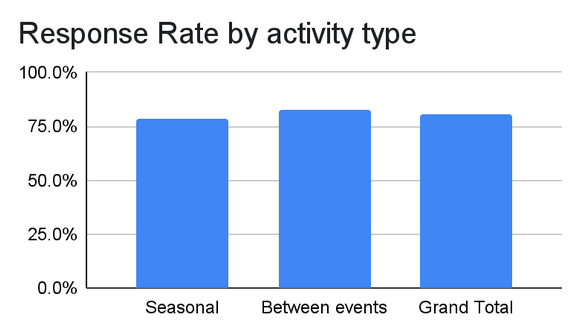
Both seasonal and non-seasonal Knights are equally likely to respond to an out-of-season “Call To Arms”
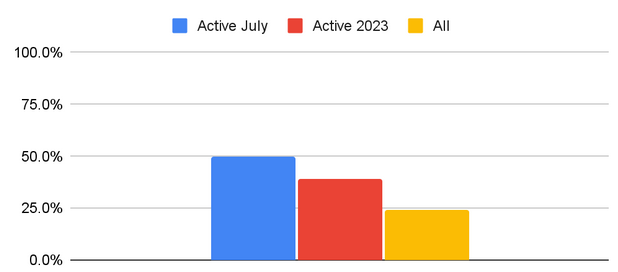
Focusing on the Knights that were active in July, only half of them voted. Knights that were active at any time this past year, the interest in voting was even lower.

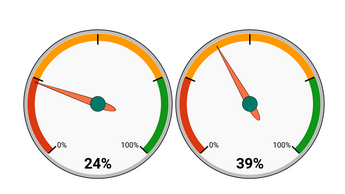
Our voter rate is lower than our July activity rate, despite being advertised longer. Our voter participation rate is not due to a lack of opportunity. Moving it to a slower time of the year will not suppress votes; it will give us time to focus on the election without suppressing the fun stuff.
Section III - Revise Constitution
The Constitution will need to be revised to reflect the new election date.
Article 1, Section 2, point 4
The Grandmaster shall serve a term lasting from the moment they are sworn in until the next April event is finished.
Changes to
The Grandmaster shall serve a term lasting from the moment they are sworn in until the next Grandmaster is sworn in.
This bill will also preserve the already passed Constitutional revision detailed in the Election Act v1.0 here.
Section IV - Revise Election Act
The Election Act will need to be revised to reflect the new election date.
The previous version is here. The new version is here, and will replace the previous version.
Section V - Enactment
- This bill proposes a revision to the Constitution and Election Act simultaneously. If passed, both the revisions go into effect as soon as this bill is passed by both Councils. The revisions may not take effect without each other.
- If this bill passes, the next election will occur in April 2024, and will elect a Grandmaster for a 9 month term, lasting until January 2025, at which point another election will occur. The registration thread will be opened at the end of the April event and will be used for both of these elections, and will clearly state this fact. The April 2024 election will be the last mandated election in April, and it will use the time windows specified in the Election Act v1.0.
Section VI - Reversion
- In 2022 and 2023, there were 58 and 57 Knights who voted, respectively. Given that the primary concern against this bill is that a January election will have less voting participation, this bill has an automatic reversion clause.
- If the voting participation in the 2025 January election is less than 54 valid votes, (95% of the previous years) this bill will automatically be reverted. The Constitution will lose the change outlined in this bill, but keep any other changes made between the passing of this bill and the reversion window. The document version number will increase, in order to properly convey the change. The Election Act, being a full rewrite, will return to v1.0.
- The Councils may choose to override this reversion. It is possible that obvious and extraneous factors may cause the voting participation to fall below the threshold, and the Council may feel it wise to continue to uphold this bill. Examples include: Reddit declaring an end to April events, being bought by another company, or shutting down entirely.
- This reversion will be brought before the Councils no later than one week after the voting period is finished, and only if the voting participation falls below the given threshold. The Councils may vote to override the reversion with a simple majority in both Councils.
Mediation Act
If a Knight is accused of unsavoury behaviour by any member of the April Knights, all actions must be taken to address the alleged behaviour in a fair manner. This law recognises that these situations can often be resolved with communication, rather than by trial or severe consequence. This Act recognises that these situations can be complicated, and that multiple perspectives and feelings can be involved. The purpose of this Act is not to define who an ‘unsavoury person’ is, but to acknowledge when there has been ‘unsavoury behaviour’ (see A1, SI) that has created a ‘negative impact’ (see A1, SII), and how to address this effectively. The aim of the legislation will be to outline steps that will encourage self-reflection and accountability, while promoting understanding and communication. Therefore, this law outlines what behaviour this Act is relevant to, the occasions in which a mediation may be called for, the appointment of the Moderation Committee, what will happen when more than one Knight is impacted by the behaviour, and what outcomes may be used to resolve the situation. It is hoped that this legislation may free-up the Grandmaster and Upper Council from having to directly deal with all disagreements or conflict.
Article 1 - Definitions
Section I - Unsavoury Behaviour
Unsavoury behaviour is not to be confused with more severe behaviour, such as harassment (e.g. threats, derogatory comments based on gender or race), sharing inappropriate content (e.g. NSFW, explicit images etc.), or invading privacy (e.g. doxing). Unsavoury behaviour is behaviour that is less severe in nature, in which it does not need to be met with immediate repercussions.
Unsavoury Behaviour may include any of the following behaviours (Please note: This list is not exhaustive):
- Bullying.
- Spamming.
- Trolling.
- Disruptive Behaviour.
- Ignoring Rules or Instruction.
- Unfair Treatment or Instruction.
- Disrespectful Behaviour (e.g. excessive swearing, sarcasm, gaslighting, passive-aggressive remarks).
- Arguing (e.g. persistently ignoring or dismissing other participants' views, constantly pushing one’s agenda, using fallacious arguments such as mistaken beliefs as facts, or becoming accusatory towards those with opposing views).
- Malicious False Accusations or Inflammatory Finger Pointing.
If you are unsure of whether the behaviour is considered to be ‘unsavoury’, please see ‘Article 1, Section II - Negative Impact’.
Section II - Negative Impact
There may be times when behaviour is on the borderline of ‘unsavoury’. In these circumstances, it is worth looking at the overall impact the behaviour is having on either the Knights as a whole, or an individual Knight experiencing the behaviour. For this reason, ‘Negative Impact’ has been defined below. The list below is not exhaustive, and should be used as a guide only.
It is worth noting that some April Knights members have either in-person or external online relationships. The April Knights may consider the behaviour as still impacting the April Knights as a whole, or an individual member of the April Knights, if the external interaction is in relation to April Knights matters (e.g. discussing a debate in person as it occurs in the April Knights discord server).
A behaviour may be considered ‘unsavoury’ if:
- An individual or certain group of people feel alienated or targeted by the behaviour.
- The behaviour is repeatedly found to be annoying or frustrating.
- An individual or a group of people feel hurt by the behaviour.
- The behaviour has created or contributed to a negative atmosphere.
- An individual or group of people feel ridiculed, unsupported, unwanted, or unheard.
- An individual or group of people feel a sense of helplessness in their experience of the behaviour.
- An individual or group of people feel uncomfortable as a result of the behaviour.
A note on whistleblowing: it is not punishable to call out behaviour, even if doing so makes someone feel ridiculed, unwanted, etc. However, it is important to be mindful of how that behaviour was called into question.
Section III - Notifiers
From henceforth, any Knights who identify unsavoury behaviour or have been impacted by unsavoury behaviour will be referred to as ‘Notifier/s’. There is no limit to the amount of Notifiers.
Section IV - Accused
From henceforth, any Knights who are identified as using unsavoury behaviour will be referred to as ‘Accused’.
Section V - Lead Mediator
The Lead Mediator is the mediator who will conduct the mediation session, and will be chosen at the beginning of said mediation, as outlined in Article 3, Section 1. The Lead Mediator has the final say on any decision-making if more than one mediator is assigned to a mediation session.
Article 2 - Moderation Committee
Section I - Formation of the Moderation Committee
A Moderation Committee shall be formed, comprising a minimum of three (3) and maximum of five (5) distinguished Knights of an Officer Rank.
Section II - Selection Criteria for Committee Members
- Committee Members must not have been a part of any mediation as an Accused in the past twelve (12) months.
- Committee Members must commit to being fully impartial, and be able to recognise when they may be biased. In the case of personal bias, they must be willing to hand over mediation duties to another member on the Committee.
- Committee Members must have been active within the April Knights during the last twelve (12) months, including participation in at least one Reddit or April Knights event as a Knight.
- To ensure this Act upholds the intention of reducing Grandmaster and Upper Council member involvement in minor conflict, these Officers must not currently occupy a seat on the Upper Council. The exception to this rule is one (1) Advisor may be permitted to be a member of the Moderation Committee if more than one Advisor resides on the Upper Council.
- Committee Members must willingly accept the nomination.
Section III - Appointment Process
Committee Members will be nominated by the Grandmaster and confirmed, by a simple majority vote by the Upper and Lower Council, within fourteen (14) days after inauguration of a Grandmaster. Members of either council may suggest candidates to the Grandmaster. The Grandmaster decides whether or not a proposed candidate is fit for the committee, and will have final say on which suggestions are included or excluded from their nominations.
- Once the role of Moderation Committee member is accepted, Committee members will be sworn in by a simple majority vote of both councils.
- Once sworn in, Moderation Committee members shall serve until the next committee is nominated and sworn in.
- If unfit to carry out their duties, Moderation Committee Members may be removed from their position via an absolute majority vote of both councils.
- If a replacement Moderation Committee Member is required, for any reason, the appointment process may be repeated for the replacement member.
Section IV - Moderation Committee Responsibilities
Once chosen and sworn in, the Moderation Committee shall be the main body responsible for the mediation of disputes, as outlined in Article 3. The Upper Council may bestow upon them any permissions or roles required to do their responsibilities effectively. Mediators will have the following roles, responsibilities and powers:
- Keep the mediation procedure moving as swiftly as possible.
- Treat all parties respectfully.
- Provide equal offerings of support to all members of the mediation process.
- Support Notifiers and Accused to come to a decision about what outcome they want from mediation. However, mediators are not to push for certain outcomes or try to sway either party in a particular direction.
- Collect all statements from all parties and determine the best way of sharing them to all parties.
- Promote reflection and communication, rather than finger pointing. Remind all parties that the purpose of mediation is not to determine if a person has acted unsavoury, but to recognise that the behaviour had an impact and to find a way to move forward.
- Providing guidance on how to proceed with mediation discussions. The mediator is not there to control the conversation, but as an unbiased guide and supporter to all parties.
- The mediator may utilise private messages, threads, or channels to conduct proceedings.
- In the event that there is confusion over who should be identified as a Notifier or an Accused, the mediator may discard all titles (i.e. refer to all parties equally as participants and avoid any ‘Notifier’ or ‘Accused’ private channels), or use known evidence to determine which party the individual most fits with.
- The Lead Mediator can decide that mediation is not the best course of action. In this case, the Lead and any supporting mediators are to report back to the Upper Council with any recommendations on consequences or next steps (see A4, SII: Unsuccessful Mediation).
- With consultation from the Upper Council, the Moderation Committee can decide whether it is purposeful to share the outcome of the mediation in a public way.
- The Moderation Committee may decide to remove observation (see A3, SII, b) or support person (see A3, SII, a) privileges if they negatively impact on proceedings.
- Moderation Committee Members must maintain the confidentiality of the mediation process as much as possible. If confidentiality must be breached, Moderation Committee Members must provide justification and notice to all mediation participants.
Any decisions that need to be made outside of the above responsibilities should be made with consultation from impartial Moderation Committee members or impartial Upper Council Members.
Article 3 - Procedure
All April Knights are expected to promptly and respectfully address unsavoury behaviour. If attempts at resolving the issue in-the-moment are unsuccessful, then the Mediation procedure can begin.
Section I - Mediation Preparation
a) Security Considerations
Before mediation is conducted, if the Grandmaster or the Grand Inquisitor determine that a security risk warrants such actions, a Knight accused may have their privileges temporarily revoked. These may include access to any and all Knight exclusive communication channels. The temporary nature of this preemptive action must be made clear to the accused and any who may witness this. Actions taken for security purposes should not imply unproven guilt.
b) Identifying the Impacted Parties
In the case that mediation is required, a Moderation Committee Member will announce that mediation is required, either by:
- Addressing the behaviour privately via DM if there is a singular Knight impacted by the behaviour.
- Addressing the behaviour ‘publicly’ if it has occurred in a ‘public’ or ‘Knight-only’ discord channel, including those channels limited to set Knight Roles (e.g. #Lower Council).
The Moderation Committee Member will ask all negatively impacted parties to make themselves known via private message or the ‘#ModerationTicket’ channel. All members who feel they have been negatively impacted are given twenty-four (24) hours to request to be a participant of mediation.
At the end of a twenty-four (24) hour period, the Accused Knight will be informed of how many Notifiers will be partaking, and will be given relevant updates on progress and procedure in the lead up to mediation.
c) Appointment of the Lead Mediator
All Notifiers and Accused must identify their preferences of who they would like to preside over the mediation process as ‘Lead Mediator’ (i.e. identify one or more mediators they believe will be unbiased). AND any mediators they believe would be inappropriate to partake as mediator for this circumstance (Lead or otherwise), with justification. To avoid delays, the Moderation Committee may request this information be provided by Notifiers at the time of identifying themselves as a mediation participant. All attempts should be made to appoint a Lead Mediator within Forty-Eight (48) hours of a mediation announcement.
In the first instance, mediators who have been identified as a preference (excluding any identified as inappropriate with justifiable reasons) will determine whether they are capable of taking on the task of mediator, using the below indicators of suitability. If those with a preference are not suitable, mediators who are neither excluded or preferred will determine whether they are capable of taking on the task of mediator, using the below indicators of suitability.
Indicators of Suitability:
- Does not identify themselves as negatively impacted by the Accused's behaviour, regardless of whether they decided to participate in the mediation process as a Notifier or not.
- They have the time and capacity to begin mediation within a maximum of three (3) days, and the availability to respond to mediation within the seven (7) days after mediation has been announced (Or two to three (2-3) mediators are chosen that can provide this coverage so that matters are resolved quickly).
- They continue to uphold the eligibility requirements to become a Moderation Committee Member.
In the rare instance that no Moderation Committee Members are suitable, the Moderation Committee may elect a Temporary Moderation Committee Member to become Lead Mediator for the duration of the seven (7) days of mediation. A Temporary Moderation Committee Member must meet the criteria as set out in Appointment Process (A2, SII) and indicators of suitability above.
Section II - Mediation Tools
a) Support Persons
As mediation’s purpose is to open communication and promote accountability, it would not be beneficial for any Notifier or Accused to have a ‘representative’, or someone who speaks on or formulates statements on their behalf.
Traditionally, a support person’s role is to act as a semi-silent supportive bystander, meaning they might offer advice to an individual throughout mediation but otherwise do not talk on their behalf. Therefore, a support person may have a relevant role in mediation if a Notifier or Accused feels they need the support of someone directly..
In these cases, a support person must meet the following requirements:
- They are not in a position that may influence the outcome of the mediation, whether they would intend to do this or not (e.g. as Lower and Upper Council members hold a position of power and can potentially sway others opinions unintentionally, they are not a suitable candidate for a support person).
- They are not a Notifier, Accused, or member of the Moderation Committee themselves.
- They agree to only contact the person they are supporting regarding the mediation directly.
- They agree to uphold confidentiality of the mediation process.
- They have the time and capacity to provide support during the seven (7) days after a mediation is announced.
b) Mediation Observers
Mediation observers should be kept to a minimum to ensure privacy of all parties involved. No observation thread should be made. Those who may view, but not participate in, any private mediation threads created are limited to:
- The Grandmaster.
- The Grand Inquisitor.
- Members of the Moderation Committee that are impartial to the situation.
- Support Persons.
Article 4 - Outcomes
Section I - Successful Mediation
The outcome of mediation will depend on the negotiations between the Notifiers and the Accused. Since this Act deals in less-severe but still negatively impactful behaviour, the following outcomes may be appropriate:
- An official apology and acknowledgement made privately or publicly.
- A warning.
- Public admonishment.
- Temporary mute for some or all April Knight communication.
- A temporary ban on succession/ promotion/ division acceptance for a period of six to twelve (6-12) months.
- A temporary role-removal for a period of six to twelve (6-12) months. (e.g. Council Observer role or Builder status revoked).
- Transfer to another battalion.
- A step down from rank (including demotion from the Upper or Lower Council) with the possibility of reapplication after a set timeframe (a return to rank is never guaranteed).
- A temporary exclusion of responsibilities (e.g. Unable to have a final say on Interview acceptance/denial for a period of six to twelve (6-12) months).
The above list is not exhaustive, and more than one outcome may be used to resolve the matter. Once the mediator identifies that proceedings have come to a resolution, the mediator will summarise the mediation process and confirm all parties are willing to mark the matter as resolved. The summary and outcome of the mediation will then be shared with Upper Council, and where appropriate, Lower Council Members (i.e. after non-private conflict).
Section II - Unsuccessful Mediation
Mediation may be deemed ‘unsuccessful’ if:
- Mediation remains unresolved after seven (7) days since mediation was announced. This remains valid even if mediation was delayed due to waiting for statements, or mediator availability.
- It is clear no resolution can be reached.
- Mediators are finding it difficult to keep conversation civil or productive.
- The unsavoury behaviour continues.
In this case, the mediator/s can advise the Upper Council on their observations and recommendations for next steps / outcomes. Outcomes may include any of the outcomes listed in Successful Outcomes (A4, SI). Or, the Upper Council may decide the behaviour in question needs more action. If the Upper Council believes further action than outlined in this Act is required, other procedures or legislation may need consultation (e.g. The Trials Act).
Article 5 - Implementation
The Mediation Act will come into effect immediately after majority vote in the Upper and Lower council. The Moderation Committee shall be formed immediately after this bill is established, as outlined in Article 4, and re-formed after each election as per the Appointment Process outlined in Article 2, Section III.
First Herald Renaming Act
As the April Knights grow and change as an organization, roles can change in meaning over time, and this bill hopes to reflect that as well as make other minor changes to the role currently known as the First Steward.
In the past, the First Steward was our foremost diplomat and steward of the image of our realm, however during LadyVulcan’s Grandmastership, their duties were changed to being the division leader of the Heralds, and as such, their name should reflect this change.
Section I
The full list of changes are below, organized by document.
April Knights Constitution:
- Wording is changed in Article 2, Section 1, replacing “First Steward” with “First Herald” Mutare Magic Act:
- Wording is changed in Article 4, Section 1, replacing “First Steward” with “First Herald” Trials:
- Wording is changed in Article 2, Section 2, replacing “First Steward” with “First Herald” Line of Succession Act:
- Wording is changed in Article 3, replacing “First Steward” with “First Herald”
- Wording is changed in Article 4, replacing “First Steward” with “First Herald”
- Wording is changed in Article 5, replacing “First Steward” with “First Herald” Vindicaris Maximus:
- Wording is changed in Article 1, Section 1, replacing “First Steward” with “First Herald”
In order to preserve the history of the Knights, one exception to the title renaming exists that shall not be changed: "First Steward Gryph", who is listed as the author of Vindicator Maximus.
Section II
An overview of changes made to the Document Standardization Act:
- Article 2, Section 1, is changed to the following: “For the sake of preservation of April Knights history, the First Herald will appoint any officer ranked Captain or higher, other than the Grand Inquisitor, with the charge of maintaining April Knights documents. This Knight will be known as the Scribe. The First Herald may choose themselves, and the Scribe duties outlined would fall on them during periods in which the Scribe position is unfilled. The Scribe position is not an Upper Council position.”
Section III - Enactment
This bill will go into effect at the time in which it has been voted on and approved by both Councils.
Governmental Document Empowerment Act
Purpose
To ensure that changes to the laws of the April Knights are well maintained, to reduce the maintenance burden of tracking old changes, and to increase the ease of making needed changes in the future.
It is the intent of this act to move the April Knights towards a proper Version Control System (VCS) for all official government affairs. Moving to a VCS will also have the benefit of allowing the April Knights to tighten the scope of text within the statutes, making it faster and easier to read the legislative rules while still allowing for greater insight to be available when needed.
This act does not prevent non-official usage of other systems such as google docs for government and similarly does not apply to anything that isn't part of the official governing documents of the April Knights.
Definitions
- Bill: A proposed change to the governing rules of the April Knights that must pass both the upper and the lower council.
- Act: A legislative document.
- Statute: Specific rules related to the operation of the April Knights as designated by acts.
- Law: Any legislation that has been voted on and passed to become binding.
- Repository (Repo): A collection of related files and folders that are stored together in a single place.
- Version Control System (VCS): A generic term to describe tools that are purpose built for tracking changes to a central repository.
- Git: The most widely used VCS implementation.
- Github: The most popular website for hosting git repositories.
Background
If passed, this act codifies the creation of separate acts and statutes for the April Knights. Statutes are the written rules that govern the order. Statutes are enacted, amended, and repealed by acts. Acts also contain the broader conversation about the statutes. Using the order's VCS, both councils will vote on acts that may each effect changes in any number of statutes.
One driving intent with this act is to make it so that it is easy for our order to preserve the work that has been done in the past (specifically the who, what, why, and when of legislation). By separating the acts from the statutes and adding appropriate metadata to the legislation (Authors, date passed, etc.), the past is indeliby written without being a maintenance burden for the order in the future. As an example, our current structure makes it hard to tell how many people have specifically amended our constitution. Using a VCS, this become trivial as all authors of changes to the constitution are tracked right along side their contributions to the constitution.
Legislative Procedure
Acts should generally be composed with useful headings to provide additional clarity aligned with purposes such as the following:
* Purpose: A brief overview of the change or issue it seeks to address.
* Definitions: Anything that may need clarified within the bill text (including usage within the statutes).
* Background: Additional context, relevant history, or justification for the bill.
* Statutory Changes: List the documents or sections that are intended to be changed by the bill, optionally with links.
* Enactment: When and/or how the act is to take effect along with any automatic or other expiration clause (think "implementation").
The above is not an exhaustive list of headings that may be used within an act, but should be considered a starting template when drafting a bill. Templates for suggested documents such as Bills, policy change requests, constitutional amendments ad al will be provided and expanded to assure consistency across current and future experiences. If a template doesn’t exist, it can be requested via a discussion in the Lower Council or Consult the Council ticket.
Each article or section heading may be listed with an article or section number and the heading name or just the heading name. Acts and their corresponding statutory changes should follow the markdown standard where possible.
When a statute update doesn't have a clear act associated with its change, it may be noted what the effective date of the version is along with what act caused the change (such as in the case of 8-104 (Election Act) which edited the constitution at a later date)
The authoritative list of governing documents is to be maintained by the Arcaenum and shall be known as the official April Knights repository.
Migration Notes
There are some minor changes made to acts, as a part of migrating to the VCS, that change their links or remove specific text from the act, in order to prevent duplicating text within the repository. Preventing unnecessary duplication makes it easier to find exactly what is desired in the statutes quickly.
The First Herald Renaming Act (FHRA) calls for changes that don't make sense in a VCS to the Mutare Magia Act (MMA). FHRA calls for the MMA to be updated to version 7.1. However, in the VCS, acts don't have versions or updates; once an act is passed, it never changes. Only statutes have versions because they are the documents that get edits from acts.
Statutory Changes
All governing documents within the April Knights are officially changed as a result of this act, so they are not being listed individually. In all documents, most numbering has been removed as it is no longer needed and only increases the maintenance burden of keeping things up to date.
As the arbiters have been removed from the order, mentions of them also are removed.
The most significant changes be reviewed from this act:
- Legislation (renamed from Voting to Legislation)
Workflow
As an example of what the workflow would look like for proposing legislation:
- Fork/clone the repo to your own git repo.
- Create your bill in the Acts folder.
- Enact, amend, or replease statutes as needed in the Statutes folder.
- Submit a pull request and announce in council as normal for the legislative process.
Enactment
This act will take effect as soon as it passes the Upper Council and Lower Council. Future changes to further simplify or make statutes more intuitive should be expected, but there are no riders that automatically enact anything more than what is contained in this act.